Why This Chord Notation Makes NO SENSE! [To The Uninitiated]
If you’ve ever found an ‘altered’ chord notated in the wild, you may have asked yourself what that chord might mean...
... and if you looked it up, you were probably incredibly frustrated to learn that something like ‘G7alt’ can actually mean many different things, and there is no exact answer for what notes are in this chord.
What’s up with that?
See, an ‘altered’ chord actually comes from jazz harmonic terminology. And in jazz harmony, chord names are much more... left to interpretation.
Think of typical, classical-based harmony like buying a typical item from a typical store. There’s a price tag on the item, you pay that price, the item is yours. Simple, direct, no-nonsense consumerism.
Imagine jazz harmony instead is like buying a car. It’s just lies. No one actually knows what anything costs, there are no rules, no regulations, no logic. The price tag on the vehicle exists for no real discernible reason.
What you end up paying is the result of how expertly you were able to navigate the minefield of undeclared costs, useless add-ons, and 14th century-style bartering based on a practically nonexistent knowledge of the value of the product from either you or the salesman, as the the true value of a vehicle is something so obscure that perhaps not even the supreme Godhead itself was ever supposed to know.
So, why use the jazz system, you might ask?
It’s simply because the jazz system, much like car sales, is a world where the strongest survive.
These are Roman coliseums for battles o{subtag:name|part:first|ucfirst},f wit and confidence. In jazz, it isn’t about what the chords actually are, it’s about how elegantly you interpret what the chords should be, and what you can get away with.
In car sales, it isn’t about what the car is actually worth, it’s about how elegantly you convince the salesman that you are making the best offer he’s going to get, and again what you can get away with.
Anybody can read a chord chart. Anybody can pay full price for a box of fruit loops. But just a few are born natural con-men. And this is the universal truth upon which jazz, and also car sales, was founded.
And still, after this long rant, the question remains: how does one actually interpret a chord like ‘G7alt’ effectively?
And furthermore, how does the interpretation of jazz harmony in general actually work?
Those are exactly the questions I answer in the video below!
Want to know much, much more about chord notation, composition, voice leading, and more? Check out my Complete Chord Mastery guitar course if you want to develop a complete understanding on chords and harmony on the guitar!
Video Transcription
Hello Internet, so nice to see you! I got an interesting question on chord notations. I never liked the notation for G7 altered, because it didn't say how the chord was supposed to be altered. The first problem here is that there is not one chord notation.
There are actually two chord notation and they look exactly the same to if you just read the symbols. And nobody explains that to you because for everybody it's obvious which one they are using. The point is there are two chord notation, the strict one and the jazz one.
If you're working in strict notation, meaning you typically are a classical musician or you are a rock musician or a country musician or a pop musician, all these kind of things, then A minor, for instance, such as notes A C E means just play those three notes.
Every chord symbol has a perfect interpretation in the strict notation as being this is the chord, those are the notes. This is the chord, those are the notes. Then if you have different notes, the chord name change.
If you write A, C, E, B, that's an A minor, add 9. Okay, if you write A, C, E, G, that's an A minor 7. If you write A, C, E, G, D, that's an A minor 7, add 11. In the strict notation, what you say is exactly what you mean.
And that's what most people actually use on the internet, by the way, whenever they stress about on what is the exact name of this chord. Then there is the jazz notation, which looks exactly the same.
They will still write A minor or A minor 7. Occasionally they will write A minor 7 at 11 because they can specify a specific chord. But here's the thing. When they say A minor 7 in jazz notation, they don't mean exactly A, C, E and G.
Because you can decide to add a 9 or add an 11 or even add a major 6th. The idea is that when you specify a chord in the Jazz notation, which again is written exactly the same way, okay, it's more of an interpretation of the notation than a different notation, but when you specify a chord in that, you are also implying a specific set of available tension notes.
And you are free to use them in the chord as you please. So jazz notation in this case, better, when a jazz musician writes a chord symbol, they don't mean those specific notes. They mean that's the general direction we are going, and I'm implying specific alterations.
If I want different alterations, different than the ones that are considered standard, then I will specify them so that you know that I'm not talking about the standard. Which means that you need to know the standard alteration for those chords or the standard tensions for those notes.
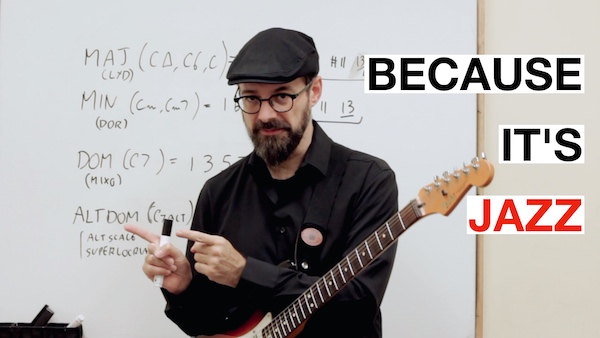
Part of learning jazz is knowing those. We could simplify this way. It could be more complex than that, but to get started, the idea is that you divide the chord roughly in four sets. Major, minor, dominant, and altered-dominant.
That's a simplification, please. Just play your don't crucify me in this, okay? It's a simplification to get started while you learn these ideas. If you have a major chord, which you will typically will write like C with a major 7, okay?
But it could be a C6 or just simply C major, okay? U would imply not only the triad, 135, and the 7th, the major 7th. The major 7th will typically be indicated by a triangle to distinguish it from the minor 7th, but you also imply possibly the 9, the sharp 11, and the 13, which is the same as the 6th.
13 or 6th. Okay? So those notes are typically not written in the chord, but you are free to add any of them to a C major 7 or a C6 to a C, depending on your taste and what you want, how you want the song to sound.
So indicating this chord just indicates that's the general mood we are going for. You decide the exact notes that you are playing. If you want, major, in this case, this is what a rock player will call the Lydian.
On a major chord, you will play pretty much the Lydian scale. Minor, so say C minor, C minor 7, and all this kind of thing, will imply the root, the minor third and the fifth and the seventh, but will also imply the tension like 9, 11, and 13.
That's the major 6th, not the minor 6th, okay? So those three are implied. So these, so again, you can play just a minor 7th, you can play the minor with a 6th, which is the 13th, you can play a minor at 9 or the minor 9, or the add 11, or this kind of thing.
It's left up to you. And so, minor, it's what a rock player would call Dorian, essentially. So whenever you see a minor chord in the jazz system, you pretty much can play anything in the Dorian scale of that chord.
Then you have the dominant. So let's say something like C7. Okay. These imply again the root, the third, the fifth, and the flat 7. Not the major 7 this time. It will also imply the 9, the 11, and the 13.
Okay, and this is essentially mixolydian. Okay, again, those are implied. You can add them, you may not add them, but when you see a C7, you can totally play a C9 or a C or a C9 or a Csus4 or all these kind of things.
Up to you to do a substitution. And here we get to the altered dominant. Those, so in which case you write C7ALT, and again, at this point it's not a mystery. You can do whatever you want as long as you stick to a specific scale, which is implied.
And so you can put any kind of alteration you want here. The altered dominant would imply the root, the third, and the seven. Notice I'm not putting the fifth right now. And it will imply either a flat nine, sharp nine, flat five, or sharp five.
So you have those possible alterations over a structure of one, three, and seven. This is the altered scale, or the superlocrian scale, depending who you ask, super locrian, which is, for the record, the seventh mode of the melodic minor.
When you play an ultra-dominant, you want to put at least a flat nine or a sharp nine or a flat five or a sharp five. And you can put one of those, or two, or three, or even or four, depending how much you can contort your fingers and how much space you have on your guitar, and if there are other instruments, but you can totally put more than one alteration in there.
And it's left to your taste. So if you are actually there and you have to play, what do you do? Well, the idea will be that you should listen to the melody and then you should play the chord position, inversion, and voicing that does not conflict with the melody.
Okay? Again, if you're doing this in theory, you'll have to transcribe what's the melody, not in the melody, make sure it's not a half step away from any of those. And just play it. Again, if you do it by ear, you just know a few positions, you try and you see what works.
If you see those symbols in the strict notation like a pop player or a rock player would write it to you, those mina is an exact specific set of notes. But for a jazz guitar player, for a jazz musician in general, those are simply four areas of harmony.
And then inside this area, you can do whatever you want. You can play anything you want. So you are left free to play different inversion, different voicing, different alteration, different tension, different position.
Move it around and just play whatever you want in that scale more than in that chord. So that it gives you more freedom to do whatever you want. It's two different cultures, okay? It's not that one is right and one is wrong.
It's simply that between the community of, say, rock player and the community of jazz players, those symbols mean something different for us. And the two different cultures, the two different communities agreed on different things when they work in music.
Okay, so again, if you are playing with a metal band and they say A minor, it's A minor, nothing else. If you play with a jazz band and they say A minor, you can play anything from the A D Audience K.
That's what it is. That's why this happens. It's not a question of the notation being more or less precise. It's a question of the notation simply meaning something different. Now, if you want to know more about substitutions and alterations and tension and what you can put it in there and actually find those things on your guitar, I recommend you guys have a look at my course Complete Chord Mastery,
where I go through chords and alteration and substitution and tensions and the voicing on the guitar. This is a course that is done directly on the fretboard of the guitar, so it's not great for piano player, but it's good for us guitar player because I'm doing all the harmony directly on the guitar and you can see those notes on the fretboard and you can see those alterations and move them around and connect the chord together directly on the guitar fretboard.
The course is complete chord mastery. You'll find the link in the description of the video. Have a look at it and let me know what you think. This is Tommaso Zillio for musictheoryforguitar.com and until next time, enjoy!