Get Rid Of BORING Chord Progressions: Do THIS Instead
Ah, the struggle of coming up with interesting chord progressions...
There really is just so many different ways you can rearrange C, Am, F, and G. And that number is 24. Which is not that high.
And once you’ve played all 24 of those combinations for the five thousandth time, you might find yourself wondering how to come up with something a little more interesting.
So what do you do?
(I mean, besides doing what most lazy people do today that is "let's ask the AI for chord progressions". Yeah, great - how are you supposed to learn how music work if you let AI do all the learning?)
The most obvious answer is ... to use other keys! And... uuuuhhhh... to use the remaining three chords in those keys instead of just using the 1, 4, 5, and 6 chords? But you’ve probably already thought of and/or done this, you clever devil, you.
So what’s next?
What’s next is the limitless world of non-diatonic exploration! If you stay within a single key, (sticking just with triads and never repeating a chord) there are 840 possible 4-chord progressions to choose from. It may seems like a lot, when you think about it!
But when you don’t bother sticking to a key, that number jumps up to a hair under 4.7 million! Woohooo!
So as you can imagine, it helps to have some guidance in navigating the sheer volume of options when you start playing non-diatonically, because the issue is the vast majority of those 4.7 million combinations sound no better than a piano falling down a flight of stairs.
So, what’s a good way to start exploring the world of non-diatonic sounds without stepping on an auditory landmine?
A great place to start is to experiment with chromatic mediants - which is a fancy, needlessly-complicated-sounding name for "chord progressions that make for famous music soundtracks".
(no, I'm not joking. Chromatic mediants are quite literally "the cinematic sound")
If you want to learn an incredibly easy way to start on chromatic mediants watch the video linked below and I’ll get you started!
Want to know even more about writing way more interesting chord progressions? If you really want to completely level up your understanding of chords and harmony on the guitar, I recommend my Complete Chord Mastery guitar course which takes you from the ground up to develop a complete understanding of harmony on the guitar.
Video Transcription
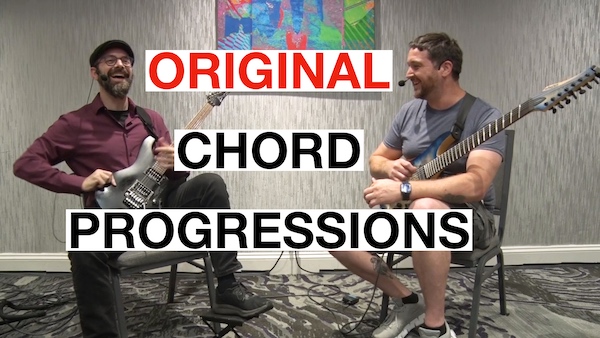
Hello Internet, so nice to see you! They tell you often that music theory is just a way to conceptualize what past composers have done. This is incredibly false. Music theory can create new approaches to music and to and with music theory can create original music.
The problem with the other approach that music theory is just a collection of what past composers did is that you get stuck into what other past composers did. But honestly, I thought that the whole point of this was to be original and be express yourself and do new things.
Okay, so let me just show you a few examples. And while, yes, the trick I'm gonna show you in this video, it's actually already known, you're gonna see how applying this trick can create new chord progressions that you haven't heard before.
And they look incredibly complex on paper, but they are actually super easy to conceptualize. It's just easy to play that. You can even improvise that. And not only that, I'm gonna show you how to write original chord progressions you haven't heard before.
And I'm also going to show you how to play a lead on that, how to play a solo on that, how to improvise on that. So it's not gonna be just, hey, let's put three chords together. It's gonna be, let's put chords together and let's also play a solo over them.
And it's simple. It is simple if you're just willing to follow me for the next few minutes. Let me show you, because a student of mine asked me about all that. And let me show you exactly what we went through together and all the little things we went through together to write original chord progression and play a lead over them.
I was wondering how to come up with new chord progressions when you kind of have writer's block and you're tired of the same old ideas. What are some ways to just kind of break out of old, quote, boring chord progressions that you hear all the time?
What's something to spice things up a little bit? Okay, so what are the boring old chord progression? Give me some examples I can give you the next. 1451, 1564, all the stuff you hear in like modern pop songs.
The atomic stuff. Yeah, yeah. Okay. So one idea is this. You start moving in thirds. Have you ever done that? A chromatic mediant, thingy? Only when I'm messing with diminished. But if you want to mess with diminished, we can mess with diminish.
We can do whatever you want. Just because that typically moves in thirds, minor thirds, but no, no. If you do it with the diminished chord, yes, but you can do this with major and minor chords. So that's play any chord, major or minor.
Can you play this somewhere higher? Yeah, thank you. So that's an E minor. Okay. Now, do you want to move up or down? Up. Okay. Do you want to move three or four frets? Say three. Do you want to play a...
In this case, let's play a minor chord in this case. So three frets higher than E minor, you're going to have G minor. So play E minor. And you're going to play G minor. Now you want to move up or down.
We can do either way. Go up again. Okay, three or four? Four. Okay, major or minor? Minor. Okay, so go up four frets. Now, at this point, it starts to be a good idea to find a lower voicing for that.
So you can... What chord is that now? The B minor. Okay, so you're going to have. How about that? Okay. Yeah. Sounds good, right? Up or down? Down. We just went up four, so we need to go down three to not go back on the same thing.
Do you want to play a major or minor chord? Let's go major. Okay, so now you're going to go down from the B minor, you're going to go down three frets to G sharp and play a D sharp, D major. And we like it or not.
Interesting. Actually, sounds awesome. Up or down? Let's go down again. Three or four? Four. Okay, major or minor? Actually, let's go three. Minor. Okay. So. How about that, huh? Very cool. Yeah? Like that?
Yeah, that's a really good. Now, soloing on that would be a problem. If you solo on that, then you want to see what modes you can play on the first chord, what modes you can play on the second. You want to hit all the chord notes.
If you want to shred, you need to study it first, okay? But you want to go like, okay, I have those chord notes, then I'm going to hit these other chord notes. So for instance, in E minor, you're going to hit like, and then you have the B flat for the G minor.
Okay, so with the E minor for a moment. G minor. What was the next one? B minor. Thank you. And then we have a... G sharp major. So you just play arpeggios, essentially, trying to fit that. And then you start to see, you don't have to play all the notes of the chord, and you just start to see how those notes line up, and if you can find some interesting melodies or some interesting situations on this.
Make sense? Yeah, that's really cool. So, it's always from any major and minor chord, you can move up or down three or four frets, and then we can play a major and minor chord. It works every single time.
Every single time. That's it. Simple as that. This is called chromatic mediant. Mediant refers to moving a chord a third away. Chromatic, because you are changing key. Because they are not in the same key.
And then you just go by ear and see when it ends, what do I do to come back to the original. Like now, the F minor, to E minor seems to sound pretty good. Yeah, yeah. So I will keep that. But yeah, you have to start listening to what's happening and then try the different option and see what works.
And make sure to voice lead those things. Okay, so don't just go up and down, otherwise it's a bit lame. Just change the position of the core so that it fits. Make sense? No, definitely. Good? Really cool.
Have fun. It's amazing how awesome that sounded so simply. I mean, I know. Very simple techniques. It's like, oh, just move up a little bit. No, awesome. Thank you very much. Thank you.