Write INCREDIBLE Chord Progressions Using The Circle of Fifths [Guitar Harmony]
Have you ever played a chord progression for someone and watched their face light up as they said: "Wow, how did you come up with that? Those chords shouldn't work together... but they do!"
No?
Me neither, for a long, loooong time. Then I made a deal with a crossroads demon Then I learned a system.
See, most guitar players are stuck in what I call "the four chord loop of doom" — playing the same progressions over and over because they don't know what else to do.
(No shame in that, by the way. We've all been there. Some of us have built a summer home there.)
There's a way out.
It involves the circle of fifths... and three "magic formulas."
Now before you run away screaming — "Tommaso, the circle of fifths sounds like something I'd need a PhD to understand!" — hear me out...
The procedure I'm about to show you is:
- Super easy to use (once you see how it works)
- Generates infinite jazzy chord progressions that all flow beautifully
- Makes people think you're some kind of harmonic wizard (you can let them believe that. I'm giving you permission)
The trick is that you don't just follow the circle of fifths mechanically — that would sound... not great.
Instead, you introduce one small change at a specific point, and suddenly everything clicks together.
I explain exactly how to do this in the video below. Fair warning: once you learn this, you may not ever write a "boring" chord progression again.
P.S. If someone asks you "how did you write that progression?" after you use this technique... you're welcome to be mysterious about it. I won't tell.
P.P.S. Remember when I said that the best way to get better at writing great chord progressions is to actually learn and study the theory to develop a complete understanding of harmony? Well luckily for you, I have compiled everything you could possibly need to know about chords and harmony, all in one Complete Chord Mastery guitar course. Check it out if you want to truly understand everything there is to know about chords and harmony on the guitar!
Video Transcription
Hello Internet, so nice to see you! I'm gonna show you a procedure to write infinite jazz chord progression. They all flow beautifully, they all sound jazzy, they are all in style and the procedure is super easy to use and typically generates also the response like, how did you get that chord progression?
How did you write that chord progression? It sounds good, but those chords should not actually possibly work together, but it sounds good. So, here's how we do it. Follow me, because it takes more than one step.
Okay, we are gonna use the circle of fifth, then we're gonna use three magic formula and you need to match those formulas to the circle of fifth and everything will work out beautifully, but follow me.
The first thing to do is that we have to write the progressions of the base of all the chords. We're gonna write chord progressions of eight chords, because in most situations you want a chord progression of eight chords.
You can make it longer, you can make it shorter, but as you see this procedure is especially suited for progressions of eight chords. First thing you're gonna do is write just the bass line, okay, just the root note of the chord.
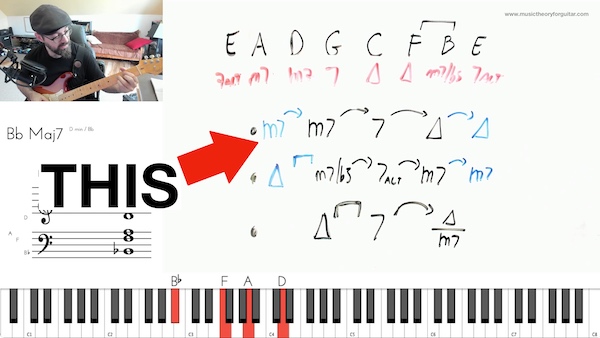
And we're gonna proceed using the circle of fifth. What we're gonna do is that we are gonna start from any note, I'm gonna start from an E, and I'm gonna go down in the circle of fifth, but I'm gonna change it at a certain point.
Because if I follow the circle of fifth exactly as it is, okay, which you can do, but not great, as you see, it will start from E, okay. And then if you go down the circle of fifth, you get an A, a D, a G, a C, an F, a B flat, an E flat, an A flat, a D flat, a G flat, which is the same as F sharp.
At this point I switch in harmonic notation, a B, even, and then again down an E. This chord progression, first of all, it's way too long for us because there would be too many chords in here. 1, 2, 3, 4, 5, 6, 7, 8, 9, 10, 11, 12, 13.
Also 13. Not a great number musically because we prefer multiples of 4. Okay, you can just go like this. So it's 12, but still not great. And also not great because it goes through too many keys. If we have to go through this, we are going very far from the beginning.
We don't want to go this far. We want to give the chord progression a sense of key, a sense of certain home feeling, rather than just going through the whole thing. So rather than going down the circle of fifth mechanically, we are going to introduce a little change.
We're going to go down the circle of fifth, and we're going to go down a perfect fifth, a perfect fifth, a perfect fifth. But at a certain point, we're gonna go down a diminished fifth rather than a perfect fifth.
Hear me out, because that's the secret of many chord progression. So for instance, I can go down, I can start from an E note again, and go down a perfect fifth, A down a perfect fifth, again, D down a perfect fifth, again, G down a perfect fifth, again, C, attention here, down a perfect fifth, F down a diminished fifth, B down a perfect fifth, E.
So when I go, when I introduce one diminished fifth, I hit the original note, 8 bar, 7 bars after, so you have a total of 8 bars, 1, 2, 3, 4, 5, 6, 7, 8. Because rather than going down a perfect fifth every time, I'm introducing a diminished fifth somewhere, and I join seamlessly with the original note, with the beginning of the chord progression.
Now, just because the note is the same doesn't mean that the chord is the same. This could be an E minor 7 or an E minor 7 5, this could be an E major 7 or an E minor 7 or anything else. So those two chords don't have to be the same, they may be, they may not be.
Point is, putting a diminished fifth does that. We can put a diminished fifth anywhere, because right now I put it here, but I could have put it after, I could have gone Bb, E, and the diminished fifth would be here, and that would be a perfect fifth.
Or I could have gone F sharp, and the diminished fifth would be here, so now there would be a different chord progression, because now I have an F sharp, not a natural F. Or I could have put a C sharp, and the diminished fifth would be here.
Or I could have put a G sharp, and the diminished fifth would be here. And so on and so forth, I could have put a D sharp here, and the diminished fifth would be here, and I could even have put an A sharp here, and a diminished fifth would be here.
The diminished fifth will be at the very beginning of the chord progression. So it can be anywhere, okay? Right now, just right now, I decide to put the diminished fifth here, okay? It's important to know what it is, because it becomes important later.
So that will be my bass line, and again, I can't change it any time, putting the diminished fifth somewhere else. I know the other notes are a perfect fifth down from the previous one. That makes it sound jazzy, believe it or not, okay?
Then I need to know three magic formulas. The magic formulas in their original formulations are these. First magic formula, it's gonna be minor seventh, seven, major seventh. I'm gonna use these symbols, and those are down a perfect fifth, okay?
So, this is a tool. 5 1 in a major key, if you know what that means. But if you don't know, just think of these as applied to thrift successive notes here, as long as you have a perfect fifth and a perfect fifth of distance.
So you never have the diminished fifth. So for instance I could apply it here and say D is the minor seventh, G is the seventh, C is the major seventh. Okay, this will sound something like that. Okay, D minor seventh, D seventh, C major seventh.
Okay, or I can apply it here to the E minor seventh, E seventh, D major seventh. I can apply it anywhere, except here, because we don't have a diminished fifth interval. Then optionally, and I'm putting the optional part in blue, you can have another minor seventh just before, always a perfect fifth away, or you can have major seventh just up.
But the main formula is those three. So that's magic formula number one. Magic formula number two, it's gonna be minor seventh, plus five, seven possibly altered, minor seventh. That's a 2 5 1 in a minor key.
And again, all those are the distances between all those chords, all those curved arrows means perfect fifths. Okay, so I could have applied it here, like D minor seventh, plus five, G altered, seven altered, C minor seventh.
Okay, or anywhere, I don't have a diminished fifth. Optionally, just after, I can have another another perfect 5th with a minor 7th, or just above, uh, just above then you think I'm right here? Just above, I can actually have a diminished 5th, uh, with a major 7th.
Yeah, some major 7th just here, so these fits the diminished 5th here. That's important because I do, because you see here in the first magic formula we never have a diminished 5th, so we can't fit, possibly fit this, but here we have this.
We have also, so that's a 2-5-1 in minor with two extra chords. Um, we have a third magic formula, again I'm gonna apply this in a second and you'll see how it works. It's very easy. Third magic formula is major 7th, then down a diminished 5th.
7th, down a perfect 5th into either a major 7th or a minor 7th, you have the option. Okay, that's a Neapolitan cadence, Neapolitan chord dominant tonic. Again, you don't need to know what any of that means, these are just three magic formulas.
Now, the idea is that to pick those magic formulas to this line here, and the best place to start is always a diminished 5th, because I have to put, I can put either this or this. In this case, since it's towards the end, I don't want to put all these.
I mean, I could put major 7, minor 7th, flat 5th, and 7th altered, and just ignore the rest of the formula. Or I can put these as long as I respect this diminished 5th. So, let's apply this formula here.
And I'm going to put a major 7 here at the end. Okay, so I'm just applying this formula here to this last three chords. Now, when I apply and I connect to the rest, I would like to always connect them to the first chord, or to the extreme chord.
So, I would like a chord progression that ends with a major 7th chord. So, I could pick those three, minor 7th, 7th, major 7th, or minor 7th, 7th, major 7th, major 7th. I'm going to apply only the black thing here.
So, I have a major 7, which would be this. The 7 becomes this. The minor 7th is this. See? So, I had one formula gave me this. Another formula gave me this. Now, I want to connect on this minor 7th. I have a nice minor 7th here, and I can just put the ones just before.
So, minor 7, 7th, major 7th, minor 7th, or minor 7th, or minor 7th, or minor 7th, or minor 7th. At the end. actually I can't because here I will have a diminished seventh and nothing will work here, so I'll actually have to go.
This G minor seven is this minor seventh here, but this is this. Here I'm going to put another minor seventh, here I'm going to put a seven altered, and I'm going to put a minor seventh, flat five. Yeah, I've done my tenmanship here, but essentially it's E minor seventh, flat five, A altered seven, D minor seven, G minor seven, D7, F major seven, B7, E major seven.
If I restart... It flows beautifully. Is that the only way of doing all this? No, of course. I could have fit the formulas in another way. I could have imagined that this diminished 7 was this diminished 7 here and apply only the part of the formula that fits here.
So I have this major 7, minor 7 flat 5, and this 7 altered. Great. Now I have a major 7 here. This could be this major 7 here, or this could be this major 7 here. It could also be this major 7 here, but then I don't have a diminished 5th to fit here because there are all perfect 5ths of distance, so I can't fit this.
So I'm going to pick this being this, so major 7, major 7, 7, minor 7th, and then I'm going to fit this minor 7th to this minor 7th here, put a 7 altered here, and a minor 7 flat 5. Again, it's an option.
I could have, since that's what we did before, let's do something different. Instead, I'm imagining that this is this, we have another minor 7th, and a 7 altered here. So I will start from an E7 altered.
A minor 7, B minor 7, E7, B major 7, F major 7, B minor 7 flat 5, E7 altered, and I can restart. If I don't like having the same chord, if I want two different chords, fantastic, then in this case, I just fit the D, fit it differently.
this is a minor 7th, this is a 7th altered, and this is a minor 7th flat 5, and so I start with a minor 7th flat 5, E minor 7th flat 5, A7 altered, D minor 7, G7, C major 7, F major 7, D minor 7th flat 5, E7, and then start again.
Okay, and it flows. What if I put the diminished fifth in another position? What if the diminished fifth was, say, here? This would have been a C sharp, it would have been an F sharp, now everything fits differently.
So, I could have fit this formula here to the end. Okay. Let me write it in blue, plus probably more visible, so G, major 7, the diminished fifth, C sharp, minor 7, flat 5, F sharp, 7, altered, B, minor 7, E, minor 7.
I need a major 7 here, which can come from this formula here, and I like to do it this way, major 7, major 7, 7, minor 7. So I'm starting from, so I adjusted this and this formula to fit. I'm starting from E minor 7, A7, D, major 7, G, major 7, C sharp, minor 7, flat 5, see, it works, F sharp, 7, altered, D, minor 7, E, minor 7, and I start again.
So, that's a possibility. Or, I could add, this diminished fifth, I fit it to this thing here, so that's a major 7, that's a 7, here I have the option to make it a major 7 or a minor 7, I can make it a minor 7th, then I can fit this, for progression here, E7 and major 7, I need to connect this major 7th here, and I can use this major 7, major 7, 7, minor 7.
So now I use only this and this. How would that work? Work this way, E minor 7, A7, D, major 7, G, major 7. C sharp 7, F sharp, minor 7, B7, E, major 7, and play it again without me. And it works, it flows, it doesn't matter where you put the diminished 7th, as long as you put 1 diminished 5th, as long as you put 1 diminished 5th somewhere, so the notes, the starting and ending notes, come at the same time.
And you use those three magic formulas, a 2-5-1 in major, a 2-5-1 in minor, and a Neapolitan cadence, and those two are here to accommodate the diminished 5th. As long as you use this, every chord progression you create by fitting those formulas to this line will work and sound and flow perfectly, okay?
You want to know more about all that, I recommend you guys have a look at my course, Complete Chord Mastery. We do this, we do more, we do a lot of other things, okay? We study all the chords on all the guitar fretboard, we see how to remember them, we see how to connect them with each other.
how to create your own chord shape when you need it, how to create different effects from those chords, how to connect those chords together in a chord progression. Then we study how to write chord progression, how to make all these into something that sounds good on guitar.
So how to create an actual guitar part, not just playing block chords all the time, not just going... But creating something that sounds better, more guitaristic, more interesting, okay? And so we studied all these, and then eventually we get up also to chord melodies.
So it's a complete course, it's in the name, Complete Chord Mastery. And I totally recommend you guys check it out. This is Tommaso Zillio for musictheoryforguitar.com, I hope you learned something today, and until next time, enjoy!