The REAL REASON We Use 9, 11, and 13 in CHORDS
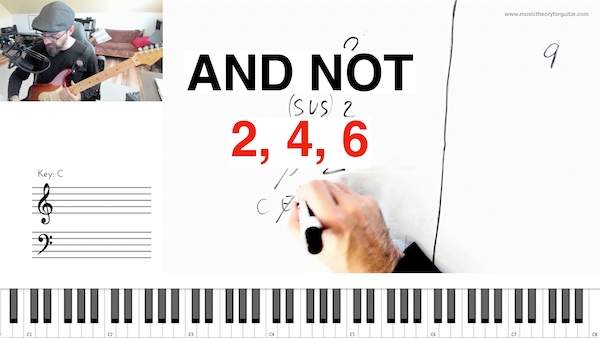
Why do we use terms like 9, 11, and 13 in the names of chords?
Almost everybody that learns music theory finds themselves confused by these terms. And for good reason: we’re musicians, and those are big numbers. It’s completely understandable to be a little overwhelmed.
So, the first thing you need to do is take those big scary numbers, and understand their much friendlier, lower-octave equivalents! In this case:
9 becomes 2,
11 becomes 4,
and 13 becomes 6.
Much better! Basically, just subtract 7 and you'll be fine! (Why 7? Because there are 7 notes in a major scale.)
In the case of C major:
the 2nd note of the scale is D,
the 4th note is F,
and the 6th note is A.
This means that:
the 9 is also D,
the 11 is also F,
and the 13 is also A.
Simple, right?
While this probably makes these terms slightly less confusing, your relief was likely short-lived as you are now definitely asking:
“if these terms mean the same thing, why the hell do we bother with having both terms at all? Why not name it a Cadd4 chord? Who devised such a cruel system?”
The short answer to these questions are as follows, in order:
Why not?
Because that sounds silly
The Italians (My people's legacy lives on through your suffering. You’re welcome.)
If you want the long answer, with actual explanations, background, and the proper justification for having multiple terms that refer to the same note...
... and especially the crucial difference between a 2 and a 9 that nobody told you before...
... for all that, watch this video:
Outside of these terms, there is still so much to learn and understand about chords and harmony that most people don't know, and it's the most important thing for any guitar player to learn. If you want to master chords and harmony on the guitar, check out my Complete Chord Mastery guitar course!
Video Transcription
Hello internet, so nice to see you! Why do my students ask me, why do nines exist? Why don't we just call them seconds? And yeah, as a point, why would we use the higher number to indicate some intervals?
Like why are we then talking about 4ths, we talk about 11ths, why other than 6ths, we talk about 13ths? Well, because musicians have a different set of assumptions when using the term second and when using the term ninth.
So while formally, if you look at the book of music theory, they will tell you that a ninth is just a second, maybe they will tell you it's a second at a higher octave, but when a musician says second or ninth, they refer to two different situations and two different sets of assumptions on how to play that interval or that chord or what to do with it.
Okay, so in this video, I'm going to show you those hidden assumptions. This is stuff you're not going to find in any music theory book, because nobody spells all this out, because you're supposed for some strange reason to get it from the air to understand it by reading a lot of music theory.
But again, in reality, that's how we use it. So what is the difference? Well, you can use the second or you can use the ninth. Okay, and let's see. There we go. Let's see what's the difference. First of all, you have to know this, to understand all this.
You have to know that when we think about scales, we think of the scales in terms of numbers like the first note of the scale, the second note of the scale, the third, the fourth, the fifth, the sixth, the seventh, and then up to the octave.
and so forth. But when we talk about chords, we rearrange those numbers to do this, to go like 1, 3, we take every other one, 1, 3, 5, 7, and then when we go up, you see that if I jump the 8, I will get the second, but I will call it 9, 11, and 13.
So we are just rearranging the notes, taking every other note, okay, again, that could be a scale. So this scale could be C, D, E, F, G, A, B, or any other scale, and when I rearrange it this way, it's C, E, G, B, D, F, and A, or again, any other scale.
Why we do this? Because if we take the first three notes of this, we get a triad. If we take the first four notes of this, we get a seventh chord. If we get the first five notes of these, we get a ninth chord.
Ninth chord, hey, okay, and so on and so forth. And whenever we mention a number, an odd number in a chord, we mean take also all the odd numbers below. So if I say I want a C9, in this case a C major 7th 9, because B would be the major 7th, I will take all the notes, C, E, G, B, and D, and play them in that chord, all the notes under the 9th.
This is an assumption, this is something that we do, and it's just, again, when we talk about chords, we rearrange those numbers, so it's not a second anymore, it's a 9th, because we think of it as coming after the 7th, not after the 1st, that will be the first thing.
So that's already one thing, and that's true, but it's not a whole story, OK? So it is perfectly true, like some people say, that a second is the distance between, I don't know, a C and a D in the same octave, and a 9th is the distance between a C and a D in two different octaves, or the next octave.
Those two intervals will sound different, OK? A second sounds like this, C and D. In fact, let me do that. C and D. A 9th will sound like this. C and D. Even if I'm playing the same notes, C and D, in both situations, since there is more distance here, these, the 9ths, sound less dissonant, because there is more distance between those two notes, OK?
So they're not so close, and the dissonance is so urgent, OK? So that's another assumption. If we see these two numbers in a chord, when I want, when I... write the 9, I typically want it far away from the root note, okay.
So, if I were to play a C at 9, I would play this D, which is the note, at the higher note. If I write a C with a second, or I imply a second somewhere, typically the second, it's now at the lower up, that you see, it's close to the C, and there may be other notes on top.
When I write a 9th instead, I typically assume this would be higher up in the chord. Now, of course, you may say, that's a suspended second chord, because, yeah, I'm also eliminating the third. It will be the E, but of course I can play the whole thing.
I can play this. I have C, D. Yeah, C, D, E, G. Okay, so I don't have to suspend it. The point is, if I play something like that with this extra note, the D, close to the root C and the third E, I will call this a second.
And if I play it as a ninth, I will put it up like that. Okay, so far. So good, right? Not a big thing. That's pretty much what you were expecting so far. But again, it's not the only thing. Because, for instance, now comes something interesting.
Okay? Something interesting is this, is that again, one of the reasons we call these seconds is because then we have the suspended second chord. Okay? And when we say suspended, you see that the third gets substituted by the second in the chord.
So if your chord was C, E, G, suspended second mean eliminate the third and put in the second. And again, in this case, you typically put these in the same note. Yeah? You're not gonna call it suspended ninth.
Okay, you can call it add nine. Okay, or you can call it add seven. Again, depending on where you want to put this. Interesting thing, though, is that there is a definite difference between second and ninth in, for instance, in counterpoint.
And the thing is that. And it's an important, important difference. In counterpoint, you typically play two or more notes at the same time. And if every time you hit a dissonance, you have to resolve that dissonance.
Okay? And there are formally specified way of resolving the dissonance. You don't have to follow those rules, okay? Those rules are there as an exercise. I'm gonna say it again. You don't have to follow those rules.
You can do whatever you want in music. But when you study counterpoint, they put those rules because... Counterpoint is not just a theory, it's a series of exercises. You go through those exercises, you learn specific skills, and then you write better music.
That's how it works. The rules are not supposed to be something you take with you when you write music. The rules are there as an exercise. Let's be clear about that, okay? So, in classical counterpoint, strict counterpoint, you would do different things with a second or a nine.
A second will resolve... It's a dissonance, and will resolve moving to a third. I'm gonna show you in a moment. A ninth... This interval expands, okay? While a 9th is typically considered to resolve to an octave, so this interval contracts, doesn't expand.
This is something that is useful even in modern music. Those tendencies are pretty clear when you start hearing them, okay? And of course you can always do the opposite, but it's good to know what is the assumption that your ear takes.
Whenever you hear a second, you're expecting this second result to a third. Whether you take the top note and you move it up, or you take the bottom note and you move it down, or you do both, by the way.
That is how a second is resolved in classical music, because it's a dissonant, you don't want to stay there. Typically you will start, I don't know, from something like that, like this, which is consonant, play the second and then play after, just after that, by keeping one of the notes fixed.
Or again, you can start from there, okay? Or maybe anything, essentially. Play something, play your dissonant interval second and resolve it to a third. You never have a ninth instead. You could resolve it up.
With a modern resolution, in classical music you would always resolve this down. Occasionally you will resolve the bottom note. up. Less common. Typically we'll resolve the top note down. Again, that's not a rule and something you do as an exercise, but when you do it, it is the most natural thing to do.
Your ear genuinely perceives seconds and nines in two different ways and since the seconds are really close, your ear wants to go further away, you want to split those two, okay, and make them become a third.
And a ninth is already far away and so it tends to resolve down, it tends to resolve contracting, okay. And so that's a difference and that's an important difference because I mean we have to use two numbers, two different numbers, sorry I didn't have the board, yeah, we have to use two different numbers here to indicate those two intervals and how they resolve, okay.
So, basically speaking, there is this difference in counterpoint, and whenever you're thinking about a 9th, you typically are thinking about a 7th chord with an extra note. If you're thinking about a 2nd, you're thinking about a triad with maybe an extra note, or even suspended, so eliminate the 3rd and put the 2nd just there.
If you're thinking about a 9th, the note is typically, the extra note is typically on the higher octave, and if you're thinking about a 2nd, the extra note is typically on the lower octave of the chord.
So there are all those assumptions going on when we say 9th or 2nd, because there are two different situations in music, they sound different, and we typically don't mix and match. As usual, you can do whatever you want.
I'm just saying that when musicians say 2nd or 9th, they mean two slightly different things. And many musicians are not even conscious of that, they just pick it up by talking with other people. And then, kind of, they do their own theory, like, okay, so 90th is just a second of the higher octave.
Sure, I mean, it is true, but it's not only that. That's the difference. And something similar, it's true for all the other numbers, 4 and 11th, or 6 and 13th, only both the 4 and 11th tend to resolve down in counterpoint, and both the 6th and 13th tend to resolve down too, so there is not such a dramatic difference in counterpoint of the difference in direction of resolution.
Okay, but, I mean, it's pretty much the same for modern music, okay? If you say 4, you are more going toward a suspended 4 or a 4th added to the lower octave. If you say 11th, you're thinking more of a 7th chord, so more notes with the 11th note added up on top of the chord, same for the 13th and the 6th, okay?
Those are the assumptions behind that, okay? Now, if you choose to follow the assumption or not, it's completely up to you after all. you don't have to follow anything. I mean, even if it's written on a score, you can always substitute the chord, change something, whatever.
You have always have the freedom to do whatever you want in music, okay? Theory just tells you how it's gonna sound and what do we mean with those things. But yeah, here are all the assumptions between second and nine spelled out for you.
Now, if you want to see how to use all this stuff in a useful way, in a musical way, in practice, on your guitar, in your daily life, as a musician, I would recommend you guys have a look at my course, Complete Care Mastery, because in there, not only I spell out the assumption, but I'm showing you everything and I'm showing you what comes after, what comes before.
How do you connect those chords? Are you, do you play them on guitar? How do you play them in many, many different ways on guitars that you can make the sound the way you want? What are your options?
How do you resolve those dissonances in a classical way, in a more modern way? How? Do you make all those sounds your own? Okay, it's not a big mystery, okay? Again, it's not a dogmatic thing like you have to resolve the dissonance of the time.
Those are exercises, and you go through them, you learn how these things sound, and then you can decide in these songs of yours it works, and in these other songs it doesn't, and so you do completely the opposite.
You learn how it sounds, you learn what is happening, you learn how music works, and then at the end, you do whatever you want. Theory is not a straight jacket. Theory is a recipe book. This course is the recipe book.
Have a look at that, and it works directly on your guitar. Not a lot of fancy theory, but a lot of practical things you do on your guitar. Check it out. This is Tommaso Zillio for musictheoryforguitar.com and until next time, enjoy!