How To HARMONIZE Out-Of-Key Notes In Your Melodies
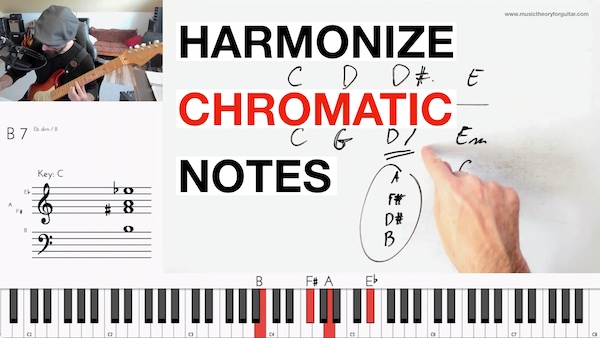
Here's a scenario every songwriter hits sooner or later: you're writing a melody, everything's going nicely in your key, and then — a note that doesn't belong shows up. Maybe a D# in the key of C. Maybe a Bb in the key of G.
Your melody wants that note. It sounds right melodically. But what chord do you put under it?
Most people either avoid the note entirely (boring) or throw a random chord at it and hope for the best (terrifying). But there's actually one rule — known since the time of Bach — that handles every single out-of-key note. And it sounds way more sophisticated than you'd expect from something this simple.
27 Chord Progressions From 3 Notes
Before we even get to the out-of-key part, here's something fun: even a simple C-D-E melody fragment in the key of C gives you 27 possible chord progressions. Three chords per note, three notes — 3 × 3 × 3. And that's before going chromatic.
I love when people tell me they have no ideas.
The Rule That Changes Everything
In the video below, I show you the complete rule for harmonizing out-of-key notes, with live demonstrations going both directions — notes resolving up and notes resolving down. I also show you why the rule works (spoiler: dominant seventh chords) and how to extend it further with substitutions.
If you want to take your chord knowledge deeper — especially voice leading, which makes these progressions flow beautifully — have a look at my Complete Chord Mastery course. We start with voice leading directly on the fretboard from session one, and build all the way up to advanced substitutions, Neapolitan chords, augmented sixths, and more.
Video Transcription
Hello Internet, so nice to see you today we see how to harmonize the out of key notes in your melodies. This what I'm showing you today is what I call the standard way. It's the easy way, the default way, it is surprisingly sophisticated in its sound, it works, it is of course infinitely expandable like everything in music and there are more ideas you can have about that because harmonization is an infinite topic, it's a bottomless pit of knowledge but this way works and you need to know and it's like if you're a musician you need to know this, okay? And it gives you pretty cool chord progression, okay?
So here's the idea, first of all what is harmonization? In this video we go out of key, it's a very advanced harmony, okay? So what is harmonization? The idea is that I can have a melody, the melody I had a moment ago was C, B, B sharp or if like E, technically a D sharp because I'm going up, okay? This melody is generally in the key of C but in the key of C I'll have C, D and E. Here there was this extra note and when I came back the extra note was still there, okay?
So and this note, it's out of key, okay? And that's not the only note out of key, I can have lots of notes out of key. Once I'm in the key of C, I can have, I mean the key of C has seven notes, there are five notes out of key, in fact there are ten because you can go up or down with each one of them. Anyway, how do we harmonize those?
Indeed, just to be sure, how do we harmonize the one in the key, okay? There is the general principle of harmonization which I'm just gonna state right now, which is this. Whenever you have a melody, you harmonize the notes of that melody with a chord that contain that note, melody note, chord note.
You take the notes of the melody, you could harmonize with one chord per note or more, one chord per more notes, but in general the idea is that you look at what notes you have in the melody, you see which one are the most important or the most common or the one held for longer or whatever, and then from, you use the chords, the chord or chords that contain one or more of those notes in the melody.
Since my melody, if I had only a melody that goes like C, D, E, that would be the melody, I would have a different way to harmonize that melody because, and I'm gonna do only triads right now, that C note in the key of C, that C note is in three different triads, it's in C major, it's in A minor, and it's in F major. So I can pick any of those three chords to harmonize properly this note.
The D note is in three possible chords, it's in D minor, it's in G major, and it's in B diminished, the triad, and this E note, it's in E minor, it's in C major, and it's in A minor, so technically any of those, any choice of these, any choice of these, and any choice of these, it's a legit choice to harmonize this C, D, E melody.
In practice, there's three possibilities here, three possibilities here, three possibilities here, three times three is 27 possible different chord progressions. I love when people tell me I have no ideas, I just give you literally a fragment of a scale, and 27 chord progressions came out of it without even thinking.
Okay, so knowing music theory really helps for creativity because you have tons of options immediately, and we have yet to go out of key. Okay, now, not all those chord progressions sounds fantastically great, but many do.
Okay, so for instance, if I take A minor here, and then I take, I don't know, A minor, D minor, and then, I don't know, C, that works. Okay, if I take C, G, and then E minor, it works. So if I take C, G, A minor, it works. If I take C, D minor, not great, I don't like this transition here, but A, and then maybe go to A minor, it works. I can start from F, then D minor, better, and then A minor.
Oh, I mean, again, not all of them will sound great, there are definitely better and worse, or in general, at least context dependent, but that's how you harmonize. You pick chords using the note, you pick chords that contain the note of the melody. Now, the problem in chords, in the key, that contain the notes of the melody.
The problem when you go out of key is that you have notes that not fit the melody, the key. Your chords don't fit the key, because if I take a chord progression like C, D, and then D sharp E, that note is not in our key of C. And so what am I going to do with it? It's a problem.
So there is actually a very fantastically simple rule. Okay, and now six minutes into the video, I'm telling you, okay, the very fantastically simple rule to pick up, to pick those out of key chords that work for those out of key notes.
Now, so out of key, those notes typically move by step, or at least resolve by step. It's very rare to hit an out of key note and there is a jump after that. The note goes either a step up into a note of the key, or a step down into a note of the key.
So if the out of note key resolves up, resolves up, then it is the third of a dominant seven, of dominant seven chord. I'm stating it, I'm showing it to you later. If it resolves down, then these notes, it's the seventh of a dominant seven.
Take a screenshot right now, copy it, write it somewhere, tattoo it in your shoulder, whatever. It's important. This rule, I'm going to explain in a moment because just reading it is not great, but this gives you so many options immediately. Now you just justified every note that is out of key. If you just played the right chord with that. I cannot stress how much gold I'm giving you to you guys with this rule.
OK, and now let's see it. My chord progression before, sorry, my melody before was C, D, D sharp, E. Since this note here resolves up from this D sharp to an E, it is customary to call this D sharp as opposed to E flat. Sharp means it's going to resolve up in this situation.
OK, if I had the opposite, which I'm going to have later where I have E and then E flat D, the same note, at least in harmonic, I was going to call E flat because it's moving down. OK, that's the function of having sharps and flats as different notation. Sharp means it's going to resolve up. Flat means it's going to resolve down. It's kind of a warning that we musicians give to each other, OK, through the notation.
And as you're going to see, this is actually going to help us a lot. OK, so I can, that's the melody, C, D, D sharp, E, and I can harmonize however I want. When I harmonized it before, I put a C major chord here, a G major chord here. And again, it contains the D chord. And I put an E minor chord here. But again, you had all the options we've seen before. So no problem.
Now, if we read our rules, if you took a screenshot like I told you, you can read the rule and like D sharp, if it does not resolve up, it's the third of a dominant seventh chord. Now, D sharp is the third of what? It's the third. It's the major third of B. And so this is the third of a B seventh chord. Yeah, you need to know your chords. How about that?
B seventh chord. Again, the B seventh chord contains a note B, D sharp, F sharp, and A. D sharp and F sharp are out of key. OK, when I play these. It works.
And now you can tell me, well, of course it works, Tommaso, because B seven to E minor is like a five to one in the key of E minor. Yes. And it's true. But I didn't think of that. I just said this is the third of a dominant seventh chord.
And to be fair, I could have picked other chords here because E will also fit a C major or an A minor. If I put, if I've been putting E minor, I mean, if you put B seven in E minor, it's a five to one in the key of E minor. So of course it works.
But if I put a C, it's B seven to C, you would have called it, or at least the one of you who really knows the music theory, would have called this a deceptive resolution, a five to six deceptive, five to five, six deceptive resolution in E minor. If I put an A minor into this B seven to A minor, would have been either a deceptive or a plagal, depending on who you ask, a five to four resolution where this maybe later becomes a one or resolves to a one, blah, blah, blah, blah, blah.
There's a lot of words for just saying this B seven chord can go here, can go here and can go here. It will feel different. And I'm going to play it right now so you can hear it. But they are all legit chord progressions. And even, I mean, it's good that you know if the names are different. Okay. But it's not necessary. Okay.
It still works. Or it still works. It works less than the others. Honestly, I, the B seven to a minor never been a favorite of mine, but it still does work.
Okay. So whenever we are going up, whenever the out of key note goes up, you do this kind of thing. You put the dominant seventh chord that has the melody note as its third, it will always resolve up. And then whatever chord you put here that fit that note will work. Some of them will work better than the other or give different feelings. You just need to experiment a little bit.
That's for the out of key note resolving up. You are totally encouraged. You are totally encouraged to try this with all the other out of key notes, but I cannot do all of them right now. Okay. Otherwise this video will be an hour long. Okay. But you are totally encouraged to try with the other ones.
And now what happens instead when the note goes down? Okay. So what if I have the opposite? What if I, in this case, I'll have E, my melody is E, E flat, give a bit more space here, E flat, D, C.
Well, again, the chords, I've harmonized this with an E minor, could have been anything. I've harmonized this with a G and I harmonized it with a C. And I like this G and C because it gives me a five to one in the key of C major. So it kind of feels good. Okay. But again, any other progression would have worked.
This E flat, and again, we use flat because this note will resolve down. And again, it's a warning that we musicians give to each other that this note is going to resolve down. This is the seventh of something. The seventh of a dominant seventh chord.
And if you look, what is the, what is E flat the seventh of? You're going to get an F seventh chord. Okay. So when I play this, I have E minor seven. Sorry, sorry, E minor, not E minor seven, E minor. Oh, not this E. This E flat becomes an F seven. And I have a G. And I have a C.
Now, if you didn't know about all these, you will go like, okay, what is this? This F seven is not in key. Of course, it harmonizes a note out of key, so it cannot be in key. And you'll wonder what is the function of this F seven. And then after a while, you will realize that this F seven is a backdoor cadence in the key of G. So it kind of points here, which, yeah, again, no, uncorrect. It is correct. It is right. That's pretty much the way it works.
But what if I put another note here? Because these can also harmonize a D minor. This can also harmonize a B diminished. Okay. And what if the B diminished is not really my favorite sound in this case?
I mean, and then, I mean, it still works. Okay. B diminished. We can put a D minor in again. The D minor doesn't go to the C the right way, but F seven, F seven, D minor kind of works. Okay, so G is definitely the better option here. B diminished is pretty good. But it works. It flows anyway. And this chord properly harmonizes this.
Now, of course, the challenge is to do a proper voice leading between all those chords so that they flow perfectly well. Okay. But that's not as hard. And I have videos on voice leading.
And if you want to know more, actually, if you want to know way, way, way more about voice leading, you can look at my free videos. Yes, definitely. But the best way is actually to have a look at my course, Complete Chord Mastery, which starts to do voice leading on the guitar directly on the fretboard from session one. It makes it super easy, and it makes you sound so much better.
Because if you know how to do voice leading directly on the fretboard, so whenever you whenever you play chord, you don't do the usual cowboy chords or the bar chords. But instead, you play the simpler version of the chords, but the voice lead them properly. It's easier technically, it sounds better, it makes you sound different than anybody else and better. And that's what we do in session one. Okay.
Okay. But if you do that, and you sound much, much better. So it's totally recommended you have a look at my course, Complete Chord Mastery here, because that's what I do again, in session one, and then we go expanding. So we do in the sessions later, we do substitution, more advanced harmony, we cover every kind of chord, Neapolitan chord, augmented sixth chord, etc. All in a way relevant to modern music.
Okay, have a look at that. Okay. That said, you can still look at my free videos to get an idea on how voice leading works. It's just, just the beginning. Okay.
Anyway, we do the proper voice leading between those chords, these flows beautifully. Now again, you have many other notes out of key that can resolve down and you always apply the that the note out of key resolving down in the melody, it's the seventh of a dominant seventh chord.
The idea, it's very simple. It's a simple rule. Like every rules, it can be broken or ignored. Okay. And you know that your pedal do. Okay. And but if you do not know what to do, and you want something that sounds good, this rule gives you something that sounds good every single time, every single time, every single time, no failure.
Okay, so just apply it and then later you can do something else. The interesting thing is that you can first use this rule to get a dominant seventh chord in the chord progression, and then you can apply all the other substitution that you know, or may know, or you may learn in my course, Complete Chord Mastery.
Okay, you can apply all those kind of substitution to the dominant chord to get more different chord that still fit the out of key note. Okay, it's an infinite game. Makes sense.
So this is how you harmonize notes out of key. This is not a new idea. This has been known from the time of Bach. It's still used today because it sounds good. Okay, we have it in your ear. It just works.
Okay, now, go out there, either write a melody with a note out of key or find songs that use a note out of key and see if they use this trick. Because let me tell you, if you listen to pop, rock, jazz, count, etc, when they go out of key, this is what they do. This is what they do. No more, no less. Go and check. This is Tomas Atzelio of mysteryforguitar.com. I hope you had fun with this lesson today. And until next time, enjoy.