The SHARP 11 Chord — How "Bridge Notes" Turn Dissonance Into Consonance
The sharp 11 is one of the most beautiful intervals you can add to a chord. It's dissonant, yes — but it's the kind of dissonance that makes a chord sound sophisticated, dreamy, unmistakably "Lydian." Play an A major triad and drop a D sharp into it and you get something genuinely gorgeous.
So why do so many guitarists avoid it?
Usually because someone told them it's "too dissonant," or because they played it once without context and decided it wasn't for them. Which is a shame, because that tension is the beauty. It's like saying a thriller is ruined by suspense.
That said — what if you want the Lydian flavor but with a smoother, more consonant sound? That's where "bridge notes" come in.
The Bridge Note Trick
When you stack a D sharp on top of an A major triad, you get a tritone between the A and the D sharp. That's the source of the tension. Your ear isn't wrong about hearing dissonance — it's there.
But the question isn't "how do I get rid of it."
The question is: "can I frame it differently?"
The Lydian scale has built-in "bridge notes" — notes that are consonant with both the triad and the sharp 11. When you add one of these to the voicing, they connect the two sides of the chord so your ear hears a unified sound rather than a tug-of-war.
Which notes? The major 7th (G sharp) forms a perfect 5th with the D sharp. The 9th (B) forms a major 3rd with the D sharp. Either one acts as an acoustic bridge between the comfortable triad and the sharp 11.
The result is a chord that's still complex, still distinctly Lydian — but more blended. Not a fight, but a conversation.
(And you may well decide you prefer the version without the bridge note. That sharper tension is beautiful too — it's a matter of taste, not a mistake to correct.)
If you want to go further with voice leading, chord voicings, and making any chord — no matter how dissonant — work in a progression, have a look at Complete Chord Mastery.
Video Transcription
Hello Internet, so nice to see you. I got an interesting question on the sharp 11th.
Sharp 11 is probably my favorite interval. It's dissonant, but what I find interesting is when you combine it with other intervals like add 9 or major 7, it somehow sounds consonant again and makes some really nice chords. I guess if you stack all those intervals, it's basically the entire Lydian mode apart from the 6 slash 13.
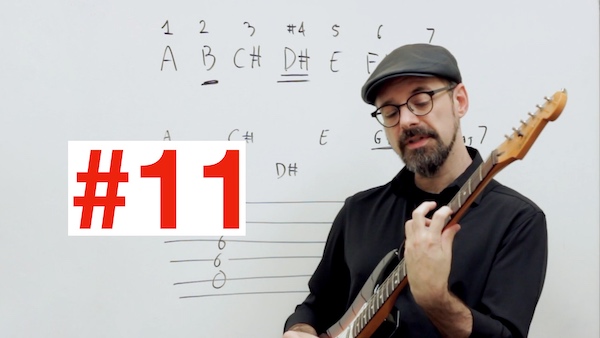
So let's write down the A Lydian mode first and see what's happening here. A Lydian is A, B, C sharp, D sharp, that's the sharp 11th, E, F sharp, G sharp, and if you put numbers on those, that's the root or 1, the 9th or 2nd of the 9th, the 3rd, the sharp 11th or sharp 4th in this case, 5th, 6th and 7th. It's like an A major scale in which I took the 4th note, which originally was D in the A major scale, and push it up a half step.
If I play the A major chord, which is made by the notes A, C sharp and E, and I add the D sharp in it, so I play those 4 notes, A, C sharp and E, which is an A major chord, and triad actually, and I add this D sharp, what I get is this. Actually, first let's play just the A major chord. That's the A major chord, I'm playing A, A again, C sharp, E. If I want to add the sharp 11th, it's a D sharp, I'm gonna play it this way, I'm gonna go A, A, C sharp, D sharp, E on the open string. And it's already beautiful. It's a fantastically beautiful chord, so you can already use it this way. And again, what I'm playing, I am doing this on a tablature here, I am playing the open string here, I'm playing 7, 6, 4, 0. That's what I'm playing right now, the A major chord and the D sharp, A, A, C sharp, D sharp, E.
But what the person who asked this question said is that this note can sound dissonant, and yes, I mean, it is dissonant, it's exactly that dissonance that gives the beauty to this chord, but you can make it sound more consonant. And it was mentioned in that you can add either the 9th, which is the same as the 2nd, so the B, or you can add the 7th, which is the G sharp. It's not a coincidence that those notes actually do something interesting to the sharp 11th, okay? It's not a coincidence because those notes are connected to the sharp 11th.
Let me show you. I could play A, C sharp, E, G sharp, this chord here right now, it's an A major 7, and then the D sharp. And if you look, D sharp is clearly dissonant with A, because they are a tritone apart, this is a diminished 5th or augmented 4th, in this case it's an augmented 4th, and so it's dissonant. C sharp, D sharp, it's a major cycle, it's dissonant. D sharp, E, it's a minor cycle, it's even more dissonant. But D sharp, G sharp, this is a perfect 5th from G sharp to D sharp. So these, those two notes are connected because they are consonant.
So this A is consonant with C sharp and E, this C sharp is consonant with this A, with this E and with this G sharp, and this E is consonant with this E and with the G sharp and the C sharp and the E, and this G sharp is consonant with D sharp. So this, kind of, this G sharp here, acts like a bridge, making all those notes more consonants with this D sharp.
How does it sound? Well, the way to do it is to change this note here and play a 6 here, so I have a G sharp, so I'll have A, G sharp, A, G sharp, C sharp, D sharp, E. Okay? As opposed to what I had before. It's a minimal difference, but it does make a difference, okay? Because those two notes here are dissonant, the A and the D sharp, but this G sharp and the D sharp are not dissonant.
Now, you may like the more dissonant version, you may like the more consonant version, that's okay because dissonance, it doesn't mean bad, the dissonance doesn't mean unpleasant, it may be that that's exactly the thing you like, you like the conflict between the notes, in which case, do not play the G sharp, but if you like the consonants, do play the G sharp. So that's one way to do it.
Or, like you were saying, we can add the B. The B is another note, and in this case, again, you'll have an A add nine in here, and this B, it's consonant with this E. It's not consonant with the A, it's not consonant with the C sharp, but it's consonant with this E. And again, this A sharp and C sharp are consonant with this E, and this B is consonant with D sharp. It's a major third of distance. So if you add the B, that's another note that can act as a bridge between the notes of the triad and the dissonance.
How do we do that? Well, we'll have to do it this way. We'll have to play... it's always a struggle to play this because there's so many notes that you can play, but I'm gonna have to play the B here, the C sharp here, and the D sharp here, and the B here. So this chord it's not the easiest, okay? But it's gonna sound this way. Which is, I mean, it's a beautiful, wonderful chord.
But since I have to play the B here, I need to play a nine here. So you kind of have a stretch from the nine to the six to this four. I mean, it's not for the faint of heart or the weak of fingers, that's for sure. I can make it because I'm kind of cheating. I'm having the guitar down here, I'm keeping the guitar very close to my face. So my arm is very close to me and I have a bit more extension when I do it this way. It's a beautiful chord. And you can totally hear how this B and this D sharp are consonants. And I cannot play it in another way like this one because in this other position here I will not have a C sharp. So I really want the C sharp.
So here's the thing. Whenever you have a dissonant note, you can either like the dissonant as it is, which is always perfectly fine, or if you don't like the dissonant or you want something different, you want something a bit mellower, you can add another note that acts as a bridge between the triad and the dissonant note. And there's always options to do that. You can always find other notes. In general, just take a scale and try to add the other notes in the scale and you see that at least one of them will act as a bridge between the consonant notes and the dissonant notes. So that's how it works.
On the other hand, if instead you have a sharp five, like the person asking was saying, what if I have a major seven sharp five, but that's a different note and it will sound in this unfortunate way. Okay, it's a chord. Let me put it this way. There's gonna be this other chord here. You will not have the open string. You're gonna have the open string zero here, and then you're gonna have six, six, six, which is appropriate for this kind of unholy chord. You have a G sharp, a C sharp, and then you have the E sharp, the augmented fifth.
Honestly, not my thing. Some people like it, some people don't like it, but like you were saying, it feels like you hit the wrong note. In the right context, with the right voice leading, this would actually work perfectly. But in that case, I will actually recommend you go and take my course, Complete Chord Mastery, where we concentrate on the voice leading, because in that course I'm showing you how to take any chord, no matter how dissonant, and make it consonant just by sandwiching it between two chords where that voice leads properly into that chord. So in that case, just have a look at the course.
But for everything else, you have this here. So whenever you have a dissonant in a chord, you either like it this way, but if you want it a mile over, just add an extra note that bridges the triad and the dissonance, and it will sound much better. This is Tomaso Zillio of MusicTheoryForGuitar.com, and until next time, enjoy!