Why Does The SLASH Have MULTIPLE MEANINGS In Chord Notation?
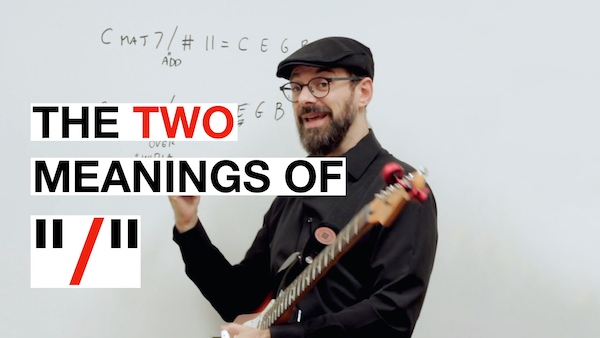
What does a slash symbol mean when you see it in a chord?
Many people think that they know the answer, but did you know that there is actually two different meanings the slash can have, depending on the context?
So while you may be familiar with chords like C/G, chords like that are not the end all be all of slashes in chords!
Now, many people find the idea of one symbol having multiple meanings to be a little silly - and they aren't wrong.
If there’s multiple uses, why not use a new symbol for the other meanings?
There’s plenty of symbols, why do we need to be recycling the few that we’ve already been using?
Simply put, the reason is entirely economic, and comes from something called ‘symbol leases’. See, when music theorists wanted to start using various symbols in music theory like the pound sign, slash, or the minus symbol, they needed to lease those symbols from the various languages or mathematical disciplines from which they originated.
This is why the symbol for ‘flat’ is simply a lowercase b instead of some other symbol which would have cost the music industry tens or even hundreds of thousands of dollars a year to lease.
The pound sign alone has cost the industry over 6 billion dollars since it started being used.
Twitter has just crossed 100 million dollars spent on leasing the pound sign, all of which is paid directly to the estate of Alexander Graham Bell.
So, the double meaning of the slash in chord notation simply saves the music industry money. Which is well documented as being the music industry primary motivation, for better or worse.
All this means that we have to do a teensy tiny little bit more memorization to know exactly how to read the various chords we come across in music, which is a small price to pay to ensure the music industry’s elites can afford their yachts and football teams.
(Ok, fine. That may not be the actual explanation. I'm a music theorist not an economist!... but it is true that the slash symbol means two different things in music. (1) )
If you want to learn how to properly understand all of the uses (2) for slashes in chord notation, watch the video linked below and I’ll explain everything!
- Well, at least two different things... who knows if some other musician used the slash in a different way? Really, for being "creative people", musicians don't seem to come up with new symbols or names for the stuff they invent.
- "All uses" = "the two uses that I know". Same disclaimer as above.
- Want to learn more about chord notation, theory, and application the the guitar? Check out my Complete Chord Mastery guitar course!
Video Transcription
Hello, Internet. Nice to see you. I got an interesting question on chord notation. C major 7 slash sharp 11. Isn't that a slash chord meaning C major 7 over a sharp 11 bass note? Wouldn't it be C major 7 add sharp 11 if there's no 9th and the root isn't the sharp 11th?
One of the problem with music notation is that it has not been developed by one person only. It's been developed by a lot of people throughout a span of centuries. And so it's not really consistent on some things.
And so, for instance, the slash, the slash symbol means two different things depending on what comes after that. So let's see a couple of chords and how we spell them. The first chord is the C major 7 slash sharp 11.
When after the slash there is a number, the slash simply means add. Okay? So this is a C major 7 and we know the notes in C major 7 are C, E, G and B. And then you have the, you add the sharp 11 which is F sharp, because the 11 would be F.
Sharp 11 is F sharp. And so this chord here, C major 7 slash sharp 11, is this chord, is made of those notes here. We need this add here, because if we just write C major 7 sharp 11 and nothing else, it would mean that you would add also the 9, so you would also put a D note.
Though the interpretation of the chord, when you actually play it, you can omit the 9 or play it or do other things. But I mean, formally speaking, C major 7 slash sharp 11, this slash, when a number comes after it, simply means add, so you just add this note to this chord.
It's a completely different situation, on the other hand, if after the slash comes a letter, so a note name. This C major 7 slash E in this case is not an add. You would read it as over, which also means with a bass.
So that would be C major 7 over E. This chord will simply be a C major 7, so the notes are simply C, E, G, and B. The only difference that this slash E simply means that the lowest note you play in this chord must be the E.
You're not going to play it normally. Normally we would play with the C at the bass. In this case, you want to play the E at the bass. So the lowest note must be an E. So the very same symbol, the slash symbol that you have here and here, means two completely different things if you have a number after it, so the indication of a degree, okay, or an interval, or a letter, so the indication of a note.
If you have the number, you just add that note to the chord. If you have a letter, so a note, that note must be the base of the chord. If you're about to write in the comment and this is bonkers and doesn't make any sense and why did I do that to you?
I didn't make the notation, I'm just teaching it to you. Okay? This was made by a lot of musicians over a long, long, long time span and they were not talking with each other and everyone had a different reason to do a chord notation.
Some of them were trying to show the theory behind something. Some of them were trying to communicate with other musicians on a gig situation. Some of them were writing music. Some of them were more theorists.
So they have all different ideas on what was the best notation because they have different goals. And so occasionally there are situations like this where there are symbols that are confusing, etc. But that's the way it is essentially, okay?
So that's what you have to deal with if you want to understand all this. So this is how the slash symbol works in notation. And yes, it's confusing, but as long as you know what I just told you, you're fine.
If you want to know much more about chord, if you want to know how to play those chords on your guitar, and you want to know much more about chords, chord notation, and how especially to make music with those chords, I recommend you guys take a look at my course, Complete Chord Mastery.
You'll find the link in the description of the video. And yeah, just check it out and write me an email if you want to know more about that. This is Tommaso Zillio for musictheoryforguitar.com and until next time, enjoy!