What Is A TRICHORD? (It's NOT A Tritone — And It Sounds Way More Interesting)
A trichord is not an interval. It's not a tritone. And it's not three steps of anything.
A trichord is simply any chord made of three notes. All triads are trichords, but not all trichords are triads — and that's where things get interesting. Because the trichords that aren't triads are the ones nobody's using, and some of them sound genuinely new.
The Viennese Trichord
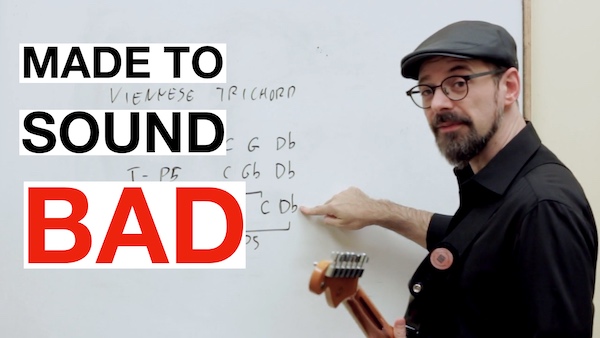
The most famous non-triad trichord is the Viennese trichord: a perfect 5th plus a tritone stacked together. Take C, G, and D flat — that semitone between C and D flat creates a deliberate, harsh dissonance. Schoenberg and the Second Viennese School invented it specifically to break away from traditional harmony.
But here's the twist: rearrange those notes and you get G flat, C, D flat — which spells 1, sharp 4, 5. That's a Lydian fragment. Same notes, completely different character. One voicing sounds like a horror movie; the other sounds like a prog metal riff.
If you want to go deeper into how chords work, how to voice them, and how to put even the strangest ones together into progressions, check out Complete Chord Mastery.
Video Transcription
Hello, internet! So nice to see you. I got some interesting questions about trichords. We don't call it a trichord because trichord is an interval of three and a half steps.
Well, there seems to be a little bit of a confusion here. First of all, a trichord is a chord, not an interval. And an interval of three and a half steps is not a trichord and not even a tritone if you think it was just a misspelling. So let's clarify the whole thing. First of all, what is an interval of three and a half steps? And then what is a trichord? And we are going to actually play something interesting with that.
So the first thing to do is, what is an interval of three and a half steps? Well, let's write the C major scale. C, D, E, F, G, A, B, C. If we start counting steps, C and D, it's one full step. D and E, it's one full step. That's a half step, so one half. And that's a full step, one. And if you sum those, one, two, and three and a half, this is three and a half steps. And that's exactly a perfect fifth. An interval of three and a half steps, it's a perfect fifth.
It's a bit of confusion here, again, because maybe it was getting confused with a tritone. A tritone would be the interval, say, between F and B, that would be a tritone. And that would be three full steps. F to G is one full step. G to A is one full step. A to B is one full step. Those are three full steps, and that's a tritone. The interval explanation of all this. Okay, so three and a half steps, perfect fifth, three steps, tritone. None of those things is a trichord.
A trichord is something completely different. Like the name says, the trichord, it's a chord of three notes. It's a generic name for all the chords of three notes. You will say, what's the difference with a triad? Well, a triad is usually defined as either major, minor, augmented, diminished triads, or three specific notes. It could be only major or minor triads. Some people define triads as only major or minor. Some people define triads as major, minor, augmented, diminished. So you have four kinds of triads.
Some people also define other stuff as triads. Some people think about the Phrygian triad or the Lydian triad. Those are different things, though, as we're going to see in a moment. The triad is typically three notes stacked by thirds, either major or minor thirds. That would be the most accepted definition of the thing. Not all trichords are triads. All triads are trichords because triads are specific notes of three chords, and trichords are all the chords of three notes, while not all trichords are triads.
But if I take any three notes that are not a triad, those would be a trichord. So if I play C, D, E, and I play this as a chord, that would be a trichord. If I play C, D flat, E, that's a trichord too. Any three notes would be a trichord, and many of them are dissonant.
There is one famous trichord, which I mention here because it's interesting. Really, the answer ends there, but there is this famous trichord, which is interesting, which was written specifically to do something different. It's called the Viennese trichord. It's made by stacking a perfect fifth and a tritone, or vice versa, a tritone and a perfect fifth on top of each other.
So if I'm starting from C, this would be C, G, and then a tritone, which is D flat. Or starting from here, C, G flat, and then a perfect fifth, which is D flat. And this C and D flat will conflate. It will sound very dissonant, and that has been written specifically to create music that sounds different than classical music. The people who invented this are the so-called second Viennese school, Schoenberg and company, who wrote very dissonant music. So this thing tends to sound, let's say, this way.
That's the kind of... This is this one, and this one will sound instead. One thing they were doing is, we have this chord, why don't we make this chord the most important part of our piece of music, and try to work around this. So, you guys want something different? This is something different.
Now, is this so different? Well, if you rearrange those notes around, for instance, if you take this one, you will discover that I can write it as G flat, C, D flat. That's a perfect fifth, of course, by definition, and that's a tritone by definition. So this sounds like one sharp four five, so it's part of a Lydian scale in this inversion. So in that case, it will sound this way.
Okay, I was just playing it a half step higher, so G flat, C, D flat. Which is still pretty ominous, okay? If you want something original, I would actually go for those, because the wide spacing and the tritone in a very unsettling position gives you something very harsh and very dissonant and new.
This, again, it's part of a Lydian scale, so it's been mined a bit more. I mean, I could hear this on a prog metal piece. I don't think I heard this on a prog metal piece, for instance, so I think that's more of a new sonority. This being older than this, those have been used less. And that's why, again, those have the Viennese trichord. And I'm just showing this to show you that a trichord... I mean, just saying it's a three-note chord sounds boring, but if you pick those notes carefully, you can actually find something that is new and not boring.
Now, if you want to know more about chords and how to put them together and how to make them sound nice or not, I recommend you to check out my other videos. If you want to know how to put chords that are nice or not nice together, I recommend you guys have a look at my course, Complete Chord Mastery. You'll find all the details on the website, so go and check that, read it through. It's just easier. And try to use the Viennese trichord in your music, or at least play it and see if you can unsettle somebody, okay, or create some horror movie music with that. This is Tomaso Zillio of MusicTheoryForGuitar.com, and until next time, enjoy!