Master the Pendulum Strum Technique: Fix Choppy Strumming & Sound Like a Pro

Have you ever felt like your guitar strumming just doesn’t sound right—choppy, uneven, and far from the smooth, professional sound you hear in your favorite songs? If that resonates with you, you’re in the right place. In this article/video, I will introduce you to a game-changing technique called the Pendulum Strum—the secret to making your strumming sound effortless, musical, and downright pleasing to the ear.
The Pendulum Strum isn’t just a trick; it’s a tool to transform your playing. It’ll help you lock in with the beat so your rhythm flows naturally, and it’ll train you to internalize the feel of rhythms until they become second nature. Here’s the best part: once you’ve mastered it, this technique will even sharpen your ability to sight-read and transcribe music with confidence. Imagine unlocking a whole new level of guitar mastery. For anyone who’s ever struggled with rhythm, this is like discovering a secret weapon—suddenly, those tricky strumming patterns will click, and your playing will sound smoother than ever.
I’ll walk you through this technique step by step. By the end, you’ll be ready to apply it to any song in your repertoire. So, if you’re ready to elevate your strumming and start sounding like a pro, let’s get started.
Transcription
Section 1
So the most important thing you need to do when learning to use the pendulum strum to play rhythms on guitar is really pay attention to what your picking hand is doing. So we're going to start off with a super simple rhythm that's just going to be four quarter notes. What I want you to pay attention to is the fact that the hand is going down and up the entire time and we're only hitting the down motion as we're playing these quarter notes.
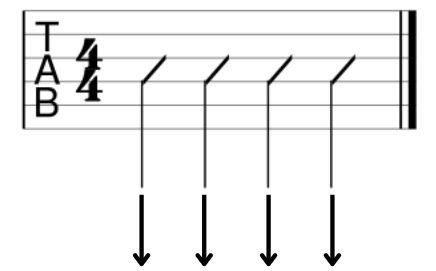
To start playing eighth notes at this tempo all you need to do is start utilizing the upstroke. It’s already happening. Our hands are already going up and down. We were choosing to only hitting the downward motion. When you play eighth notes your hand does not go any faster. It moves at the exact same speed. The only thing that changes is that you will now hit few strings on the way up. You don't want to hit all six. That will give you too big of a sound. Only hit two, three maybe four strings on the way up. It's not an exact science. If you stuggle with this you can talk your hand through the motions. Down Up Down Up Down Up Down Up. Remember that your hand motions stay steady the entire time.
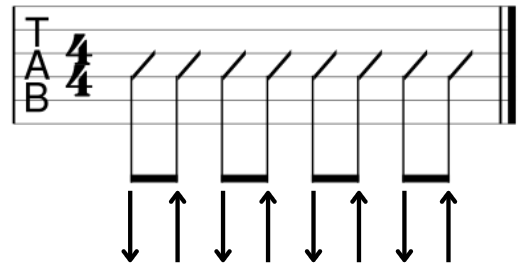
This is all you need to know to play any rhythm that is made up of quarter and eighth notes. Let’s look at a rhythm that is a combination. Your hand will keep the steady down-up motion the entire time. If the rhythm is a quarter note you miss the stings on the way up. If it is a pair of eighth notes, you will strike the string on the way down and up. Someone watching you play should not see any difference in your motion. It is a steady up and down the entire time. I dp not like to notate the missed up stokes in a rhythm. You can add in the up arrow if it helps you play the rhythm. I would add brackets () around the arrow to remind yourself that it is a missed upstrum.
So let's go ahead and do this combined rhythm.
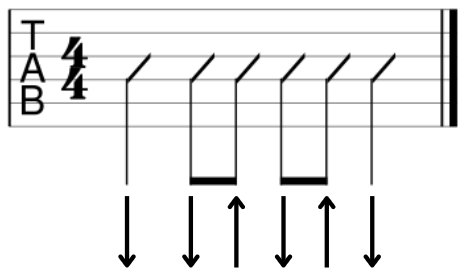
The pendulum strum even works when you apply it to more advanced rhythms. For this one we're going to add some ties or syncopation. When you encounter a tie you play the first note and then miss the note it is tied to. You let the note ring but you do not strum the second note. You have to miss a downstrum. This usually takes a some practice. For most people it is best to talk your hand through the correct motions.
Let’s play this rhythm.
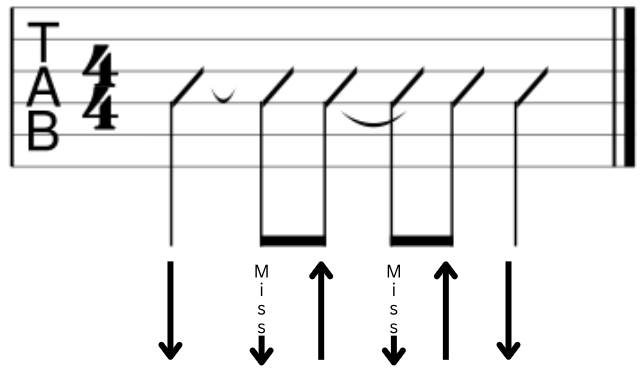
Section 2
When working with the pendulum strum, there's two speeds that you need to master. We covered the first speed in section one. When sixteenth notes are introduced the speed at which your hand moves changes. Your hand is going to make four motions within one beat.
Let’s play this rhythm.
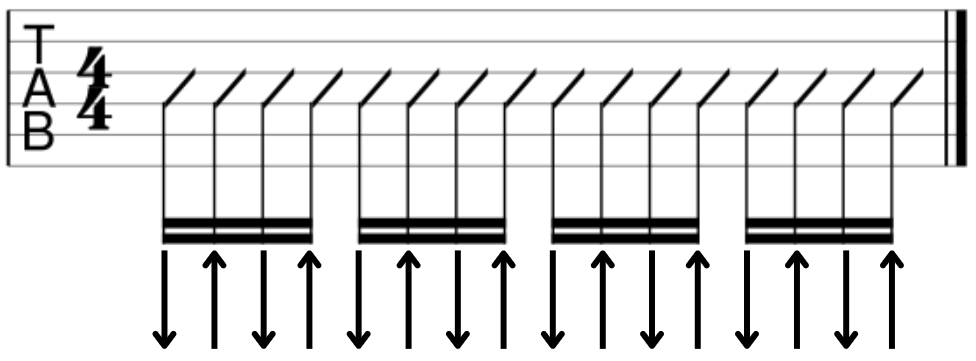
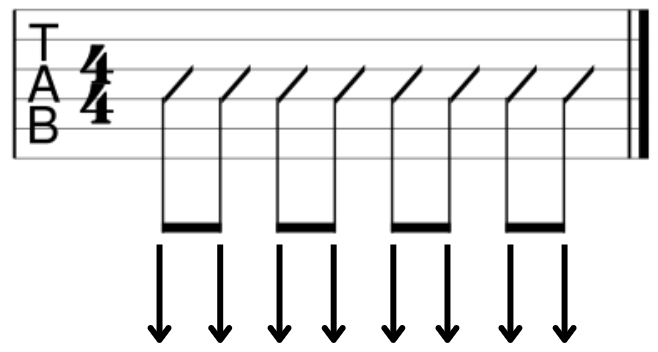
At this speed, the eight-note motion will be down–down. You miss the two up strokes that happen on the e and the a of the beat. Let’s practice making four motions but only strumming the strings on the two down-strum motions. Don’t forget to talk your hand through the correct motions
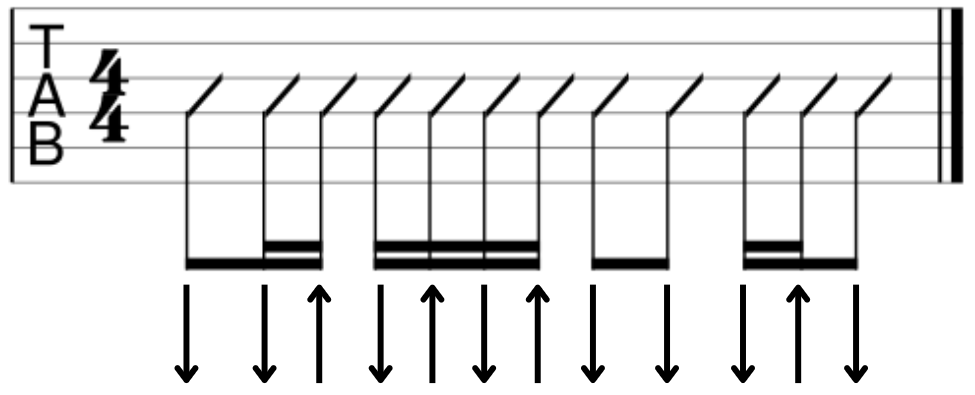
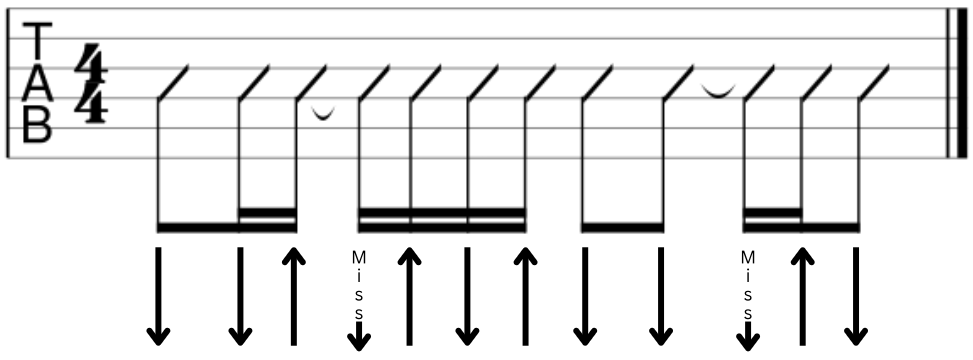
Since most rhythms are not just all 8th notes or all 16th notes, you want to start combining these rhythms to make a more interesting strum. For the 8th note combined with two 16ths, the motions are down, miss, down, up. For two 16th and an 8th the motions are Down Up Miss Up. Let’s talk our way through this strum while we play it. Your hand never stops moving.
Now, let's add some syncopation or add ties to that rhythm we just played. Remember to keep your strum hand moving in a steady down-up pendulum motion the entire time.
Conclusion
If you follow these rules, you will be able to play any basic strum pattern. If you want to learn the best way to practice rhythm in general, I recommend you check out my free video guide, “Six Easy Steps to Learn and Play any Rhythm with Perfect Timing.” In this video, I guide you through each step in the process and show you how you should practice rhythm to make the most progress. Click on the link below this video to get your free copy today.
Six Easy Steps to Learn and Play Any Rhythm with Perfect Timing