Stop Playing the Same Old Rhythms - Do This Instead
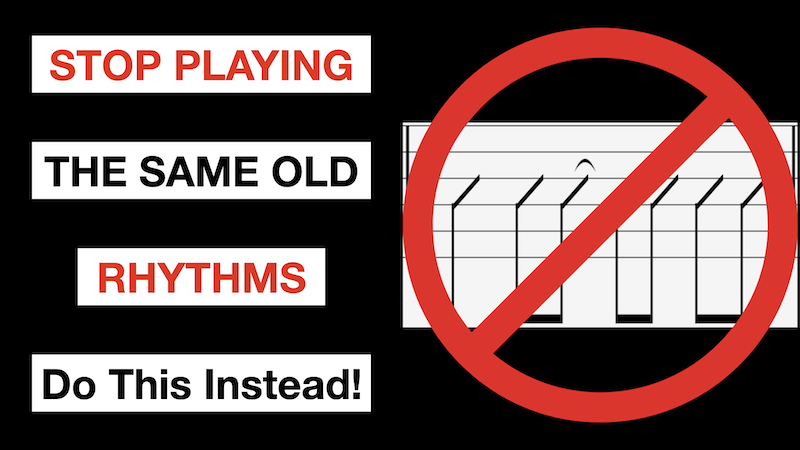
If you're like most guitar players, you've got a handful of go-to rhythms you use for everything. They're comfortable. Familiar. And after a while? They all start to blend together.
Predictable. Repetitive. Flat.
This article is here to change that.
We're going to take some of the most common, overplayed rhythms---and breathe new life into them using a method most guitarists never even think to try:
Restrictions.
Yeah, I know. "Restrictions" sounds like something negative. But when it comes to rhythmic creativity, they're one of the best tools you've got. Because when you can't fall back on your usual habits, you're forced to think differently. And that's where things get interesting.
In the transcript below the video , we apply creative limitations to everyday rhythms---and instantly make them sound fresher, more musical.
Let's start with a base rhythm. I'm just gonna play something simple---and then we're going to add some restrictions to it to make it sound way more interesting and way less predictable.

So, what was the common thread in that example?
Every measure started on beat one. Now, when you're playing in a band or with a group, guess what? Everyone is playing on beat one.
One of the easiest ways to make your part stand out is this: Restrict yourself from playing on beat one.
That's exactly what we're going to do here. And this works whether you're playing rhythm, like in the last example---or a lead line.
For this version, I'm going to skip beat one entirely.
In measures 1 and 3, I'll start on the "and" of one.
In measures 2 and 4, I'll come in on the downbeat of two.
Let's see how that changes the vibe.

Next up---here's a classic comping pattern you'll hear all the time in jazz and blues.

What's common about it? It's the exact rhythm that almost everyone plays. It sounds cool---like a big band horn section behind you. But... it can get really predictable.
So how do we fix that?
We're going to ban ourselves from playing on the downbeat of one and the "and" of two. You can still use any other beat in the measure.
Now, one way to do this would be to just shift the rhythm over---but I didn't do that. Instead, I moved the accents to:
The "and" of one, and
The downbeat of four
Here's what that sounds like.

This next one... You've heard it. You've definitely heard it---especially if you've ever been to an open mic night at a coffee shop.
It's the rhythm that gets played over and over... by just about everyone.

So how do we breathe new life into this rhythm?
Simple: Change where the tie goes.
The default spot for that tie is between the "and" of two and the downbeat of three. That's where everyone puts it.
We're going to ban ourselves from tying those two notes together.
So for this variation, I moved the tie earlier in the bar---between beats one and two. Let's hear what that does.

Since this rhythm is so overused, let's try one more restriction.
This time, I'll keep the original tie between the "and" of two and beat three---but I'll add an extra tie as well.
So now we've got one tie between beats one and two,
And the original tie between the and of two and beat three.
Just doing this makes it sound fresh and different---without completely abandoning the rhythm people recognize.

Now let's talk about another super common rhythm---the 3--3--2 pattern.
What that means is:
An accent on beat one,
Another on the "and" of two,
And the last on beat four.
So that's 3 eighth notes, 3 eighth notes, and 2 eighth notes. Here's what it sounds like.

How do you add restrictions to this?
Easy---just move the groupings around. I like to keep the idea of 3s and 2s, but rearrange them.
So instead of 3--3--2, let's try 2--3--3. Still the same number of notes---just in a different order. Now it sounds a whole lot less predictable.
Check this out.

So today, you saw how adding restrictions actually free up your creativity---and breathe new life into some of the most common rhythms.
But don't stop here.
Try this: record yourself playing. Watch it back. Notice the rhythms and patterns you always go to. Then? Challenge yourself to avoid them in your next practice session. That simple shift will push you into new territory---and make your playing way more exciting. Whether you're performing for a crowd or just trying to impress yourself, this works.
Here's the truth: rhythm is the one thing that makes everything you play sound better---instantly.
If you want to know the right way to practice rhythm---and get real results---I've got something for you.
It's a free video guide called "6 Easy Steps to Learn and Play Any Rhythm with Perfect Timing." Inside, I'll walk you through the exact steps to tighten up your rhythm, eliminate guesswork, and finally feel locked in every time you play.
Just click the link below to grab your copy today.
Six Easy Steps to Learn and Play Any Rhythm with Perfect Timing