How To Count ODD TIME Signatures — Break Them Into 2s And 3s
Odd time signatures are the bald spot in many a guitarist's skill set — and it's not because guitarists are bad at math. It's because counting to seven in a loop and making it groove are two very different things.
The good news? Nobody actually counts odd time signatures straight through. There's a much simpler way to think about them, and it works for 5, 7, 11, 13, or any other odd number you throw at it.
The 2s and 3s Trick
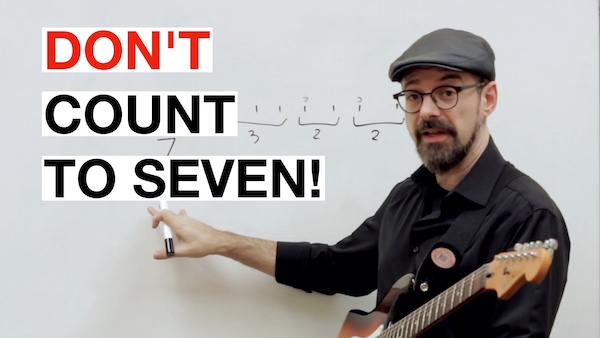
The idea is dead simple: instead of counting "one, two, three, four, five, six, seven" — which is awkward and has no groove — you break the bar into smaller groups of 2s and 3s.
So 7 becomes 3+2+2. Or 2+3+2. Or 2+2+3. Each combination gives you a different accent pattern, a different feel. And suddenly you have a groove, not a math problem.
Same deal with 5 (3+2 or 2+3), 11 (3+3+3+2), even 13 (3+3+3+2+2). Every odd time signature is just a combination of groups you already know how to feel.
If rhythm is your weak spot, check out Ultimate Rhythm Mastery by my good friend Brian Fish — it goes way deeper into complex rhythms, polyrhythms, and developing an intuitive sense of time.
Video Transcription
Hello, Internet, so nice to see you. I got an interesting question on how to count odd time signature beats. Odd stuff and counting beats are not intuitive to me. I've noticed it as a bald spot in my skill over 30 years of noodling composing. Also, chord recognition. Oh, my poor ego.
Well, odd time signatures are not natural to anyone. It's very, very, I don't think I've ever ever seen somebody who has come up with odd time signatures rhythm without being previously exposed to a culture that has odd time signatures. OK, so, I mean, if you were brought up on a diet of prog metal or on a diet of The Rite of Spring by Stravinsky or Hungarian wedding music or all this kind of thing, yes, definitely you probably have a kind of an intuitive feeling for odd time signatures because you've heard them a lot. In isolation, I don't think I've seen anybody getting that.
In fact, it is a good case that the rhythms came to be not because they are natural, not because they are intuitive, not because anybody felt them, but because there was somebody who started thinking in theory, that's actually one of the cases where music theory very likely created the music rather than being there just to explain it. Like many people would tell you, somebody probably noticed that, hey, all the music we are doing is like the count of four. It's like one, two, three, four, one, two, three, four. What happens if we count to five? And everybody was like, it's going to sound bad. And he tried in the beginning to sound bad, but then he found a way to make it sound good and all this kind of thing. So probably it started that way.
Point is, they're not natural, but you can learn how to count them. And the way to learn how to count them is for the start, for the time being, to break them in groups of three or four. So let's say that you want to learn to count something like seven fourth or seven eight, OK, but basically you want to learn to count a group of seven. OK, one, two, three, four, five, six, seven.
One thing you can do is to break it in a group of three and a group of two and a group of two. And so rather than counting one, two, three, four, five, six, seven, one, two, three, four, five, six, seven, one, two, three, four, five, which is awkward, you go one, two, three, one, two, one, two, one, two, three, one, two, which already says starts to have a groove.
Now, it's like a one, two, three, one, two, one, two, one, two. OK, that's more of a groove. If you do it this way, you are implicitly putting an accent here, here and here and that's OK. I mean, a bar of seven, whether it's seven, four to seven, eight does need some accent here and there.
And again, that's not the only thing you can do. OK, you can go three plus two plus two. You can go two plus three plus two. You can go two plus two plus three. And that's what you can do if you divide it only in three and two.
Does this cover everything? No, of course you can go, you can have a group of four and a group of three or you can have a group of four, a group of two and a group of one or in any possible order, etc. So this isn't complete, but it is a good start to get the feeling of an all-time signature.
So if you have something like in seven breaking it this way, if you have something in five, you can break it in three plus two or two plus three. OK. OK. OK, so even if in just in your mind you think of it this way and of course you need to find which one has the accent that worked best with the music you are making. But even if you're just in your mind, you do something like that, it works really well.
And after a while that you do it, those all-time signatures start to sound much more familiar to you. OK. And again, this works for five, for seven. It will work for nine, it will work for eleven. OK, I mean, eleven you have three, three, three, two, two, for instance. Actually, that's 13. Three, three, three is nine, two, 11, two, 13. OK, so you can do it with 13. I mean, if I told you I can play on a spot at 13/18, you're like, yeah, whatever. It's too complicated. It's not. Three, three, three, two, two, or any combination thereof.
OK, you can do it. You can do it now. OK, so that's a way to see all time signatures that is very beginner friendly, OK, or very intermediate friendly. And you can do this immediately. And probably for many of you, the problem is more technical, like how to change the chords more than actually how to play the rhythm. That's a way to make all time signatures more natural.
And by the way, if you are interested in those things, I have a course on my website called Ultimate Rhythm Mastery. It's been written by my good friend Brian Fish. And he goes into this and way more in depth on other things about rhythm. And it will make you able to have a rock solid sense of rhythm, regardless of what you have to play, regardless if it's all time signatures, if it's complex accents, if there are quintuplets or subtuplets, if there are estranged poses, if it's triplets or triplets and all these kind of things. This course will give you a rock solid sense of rhythm in an intuitive way until you just feel it. So check it out. Ultimate Rhythm Mastery on MusicTheoryForGuitar.com. This is Tommaso Zillio of MusicTheoryForGuitar.com. And until next time, enjoy.