How To Write MELODIES When You Have Zero Inspiration
There's a moment most guitarists know.
You sit down to play, you have all your scales, all your shapes, all your theory knowledge... and your improvisation sounds exactly like it did last week. And the week before that.
It's not a technique problem. It's not even really an inspiration problem. It's a tools problem.
Most players, when they feel stuck, try to fix it by learning more scales. Makes sense on the surface. But that's not where the issue is. The issue is that you're not connecting the musical idea inside your head to what your fingers are actually doing. And on top of that, you're not giving your phrasing enough rhythmic variety to sound unexpected.
Two things fix this. Neither of them is complicated. One of them you could start doing in the next five minutes.
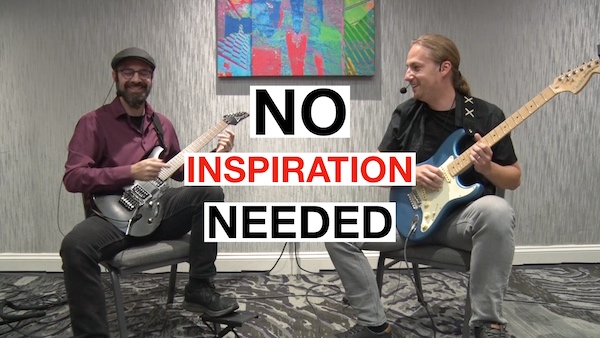
I show both of them in this video, working through it live with a student who uses pentatonics and modal scales but wants to start creating something that surprises people.
If you want to dig into the pentatonic side of this further, 18 Tips for Pentatonic Solos is a free eBook that covers a lot of ground on making pentatonic playing sound more professional. Good starting point before moving into more advanced improvisation work.
Video Transcription
Hello, Internet! So nice to see you!
If music theory can do something for you, it's this. Music theory can help you write great music, even when you have zero inspiration. Like, zero inspiration. You have zero ideas, zero inspiration, zero communication with the divinity of music. And music theory still helps you write great, objectively great music with ease.
Again, that's why you should learn music theory. So, let me show you how to use music theory to write great melodies, absolutely great melodies, new melodies every time. It's not a formula that works only once. It's something that will work every single time you apply it.
And this can work for writing melodies for songs, can work for writing melodies for your solos. And it works every time and every time gives you something new. Is it good to be true? Let me show you, when a student asked me that, how do you remedy your lack of inspiration with a lot of knowledge of music theory. And again, it's not even that hard.
Well, I feel stuck in my current level of improvising. What I do, I usually use pentatonics and modal scales, which is nothing bad with it. But I would like to expand it, like create something surprising, something unexpected. I don't mean necessarily play all the bunch of different scales, but create something more in those basic modal scales and pentatonics.
Ok, ok. I have a few ideas. So, pick a key, any key that you like. G major? G major, sure. Improvise me something in G major.
I'm playing C, F and D. G, F and... I'm playing G, C and D. I don't know why I say F. I play G and 1, 4, 5. Come on. I'm playing 1, 4, 5. You improvise anything. And then we work on that, ok? Ok.
Ok, so now we're gonna do this. Don't play. Sing me a melody.
Good. Transcribe it. Wow. Yeah, I know. Take your time. Ok. You know what you sang, so play the same.
Yeah, that sounds more like it. That's what you had in mind more or less? Sorry? That's what you had in mind more or less? Basically, yeah. Basically yes or basically no? Something in between. Something in between.
Sing or play? Sing a couple of notes. That's a B. B? That's how I heard. Yeah? You heard the same? Right?
Now, sing two notes here. Yep. G and A, yeah? Then sing something here. Ok, and F sharp.
Ok. That's how you proceed at first. The idea is to connect what you naturally sing to what you play on the guitar. To connect all this.
So, one way of doing it, which I recommend often, is that you play the pentatonic. And then you sing it. First you play and you sing. Then you try to do those two things together.
Of course, a limit on the frequency. Ok? Stay in the pentatonic at first, then go out and try to see if you can sing the half step and all this kind of thing. It's a good exercise.
At the beginning it's guitar driven and then it gets into the voice. But then it becomes voice driven and it gets into the guitar. And that's step number one.
The more you do this, the much better your ear becomes, your improvisation becomes. Because you just start to feel how the whole thing will sound. Ok?
Second thing. It's something I was given to Robert before. The idea is this. Imagine a sequence of 8 notes or 16 notes, etc. Now think of two low numbers. One odd and one even. Ok? We can do two and one. You're going to play on two notes and then rest for one note. Play on two notes and rest for one note.
Make sense? Or you can do three and two. Or you can do one and four. Whatever you want. Ok?
I'm playing the same thing as before. And you play this kind of idea where you play two 8th notes and then rest for one 8th note. And then you just keep going with the idea. You could play just 8th notes. One and two and three and four and five and six. Whatever it is, ok? Now rather than playing all of them, you play two and then you rest for one. Ok.
Make sense? Yeah. One, two, three.
Make sense? Now it's mechanical now and still it has some personality that it hadn't before. Now you can try to play three notes and rest for two. Again it has to be one odd number and one even number.
Ok. You need to sit down and study with the metronome. Get the rhythm, put some scales, improvise more interesting things. Sure. Takes a bit of time. But you see that this gives a flavor that you would not give it normally. Ok.
Then later, that's an exercise. Later you internalize the stuff and you just mix and match however it makes sense in the economy of the solo. Ok? It's just an exercise to get into that.
You do those two things, so the singing and playing together. And this is exercising rhythm. And this gives you a lot more idea and skills to do, to play different things that you are not playing right now. Make sense? Awesome. Perfect. You're fine. Thank you very much. Thank you Tom.