Play The WRONG Notes On Purpose And Sound AMAZING
Everybody knows what a pentatonic scale sounds like. Your neighbor knows. The guy at the open mic knows. The pentatonic is safe, reliable, and... well, it sounds like a pentatonic.
Then you hear a player doing these phrases that sound like controlled chaos. Notes that shouldn't work, but somehow do. Like they're stepping off a cliff and landing on their feet every single time.
That sound has a name: playing outside. And it's nowhere near as complicated as it sounds.
You already know the pentatonic scale. You can already play it in your sleep. What you probably don't know is that there's one small modification to how you use it that opens up all that controlled chaos. And when I say "small," I mean people hear the explanation and immediately go "that's too simple, there's no way that works."
It works. The real challenge isn't the technique (you'll get that in about five minutes). The real challenge is your ears. Because the first time you play "wrong" notes on purpose, your brain screams at you to stop and correct yourself. And stopping is the one thing you absolutely cannot do. That split second of hesitation is what turns "intentional dissonance" into "oops, wrong note."
In the video below, I walk you through exercises starting with just two notes, building up from there. I also show you how to control exactly how much dissonance you want, from a subtle color to full-on jazz-fusion weirdness.
If you want more ways to get creative with your pentatonic scale, grab my free ebook 18 Tips for Making Your Pentatonic Solos Sound Professional. It covers the building blocks behind great pentatonic solos, and you only need two or three of the tips to hear an immediate difference.
Video Transcription
Hello Internet, so nice to see you. Those are a few examples of outside phrases. You may love the sound, you may hate the sound.
Some people listen to this and they go like, hmm, I want that. And some people listen to this and think, ah, that's horrible. So it's completely up to taste.
If you don't like the sound, don't watch this video. If you like the sound, watch this video. If you're thinking that you like the sound of outside phrases, but you don't like the way I play them, well, still don't watch this video because I'm explaining to you how I'm playing them. So that's not the video for you.
The point is, you like the sound, you like the way I play those, here's what I did. It's actually very simple and there's a lot of space for self-expression into this because depending on how you do it, it can sound different, of course. And you can literally put your spin on it and decide how much dissonance you want to put in it.
And in this case, I put quite a lot of dissonance in it. Okay, I played a lot of wrong notes, okay? And in my opinion, I made them sound, but that's again my taste and because I want to have that amount of dissonance occasionally in my playing.
You want something more consonant, just use less wrong notes than what I did, but still put them together in the way I'm telling you right now. It is actually pretty simple.
The first thing you need to do is that you want to know how to play a pentatonic scale. Oops, there we go. I'm improvising on an A minor 7 chord and I'm playing the A minor pentatonic, nothing strange is the usual standard pentatonic scale that you know and love, okay? Nothing strange. Okay. The pentatonic scale.
Then what you want to do is to shift this pentatonic scale, okay, conceptually right now, don't actually do it, but think of the pentatonic scale that is one fret above and the pentatonic scale that is one fret below. So you have, yep, I'm playing on A minor 7th and I'm playing the A minor pentatonic, pentatonic of the same name. It works.
But I'm also thinking of the pentatonic a fret above and the pentatonic a fret below. Okay? Of course, those pentatonics sound completely wrong.
Okay, I'm not saying no, they sound completely wrong. If I get a backing track in A minor and this backing track plays A minor 7 and then plays D7, if I play the A minor pentatonic scale, I mean, it's lame if I play just this, okay? I'm not saying no, but the notes sound in. Okay, I'm just playing the scale right now.
And sure, you could tell me that on the A minor I should play A minor and then I should hit the F sharp or the D7, sure, but right now we're not even going there, okay? I'm just playing my faithful A minor pentatonic scale all over the place.
If I shift up, shift up or down, the notes now are wrong. So if I play the pentatonic a fret higher, that's going to sound completely wrong, right? Like, oh, clash. And if I play the pentatonic a fret below, that's also a complete clash. Ah, okay, like, ugh.
But if I'm starting playing from the pentatonic of the chord, and I shift and then I come back in, okay, then it sounds a bit more acceptable. So the idea is to start in the pentatonic of the chord, then move either a fret up or a fret down, or both, as we'll see in a moment, and come back into the original pentatonic.
The important point is to not stop, okay? Now I'm in a mess, actually.
Okay, so to this end, we want to do some exercise, because if we go immediately on a backing track, if you've never done this before, and you go immediately on a backing track, it's going to feel, there's going to be too much pressure on you. So you want to first do those exercises, okay? And again, it's super simple.
You can play two, three, or four notes on the A minor pentatonic scale, in any order, okay? It doesn't matter if the notes are in a specific order, in a different order. You can play two, three, actually, two, three or four notes.
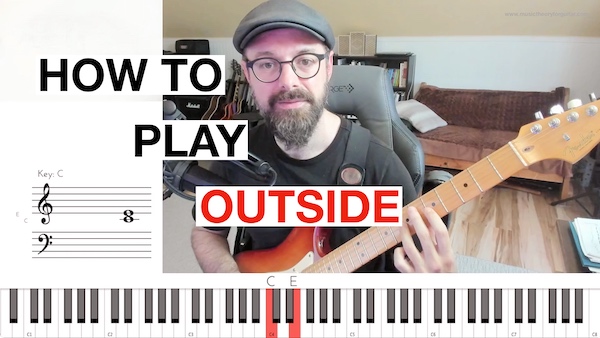
Let's start with two, okay? I'm just playing a C and an E, and what I'm going to do is simply C, E, and in fact, let me do that, let me also tell you, C and E, okay? And I'm playing C, E, and I'm going to play it on the pentatonic one fret above, and come back.
And now I'm trying to play this without stopping, as if it's a single thing. Maybe I'm playing something else afterward.
And I don't have to play them always in order, I can also go C, E, then go F, C sharp, you can play C, E, C sharp, F, or C, E, F, C sharp. Important point is that I'm playing, stepping out, coming back in.
I can do the same going down. I can play a few notes before, so, go out, down, up. It's just an exercise, I'm not saying this is the most artistic phrase you can play.
But I can also play, go up, and down, and back in the original scale. I like to go first high, then low, but you can go first low, then high, whatever.
In the pentatonic, a fret above, a fret below, in the pentatonic again. Again, you can go only up, only down, up, and then down, down, and then up. You have all the choices in the world.
And you can go, and you can play any note in the pentatonic, then play the same note above and the same note below. Technically, you don't even have to play the same note, you can play just something in the pentatonic scale, something in the scale above, etc. But right now, keep the same note, it makes it much easier. It makes it so much easier.
The idea is simply, play something in the pentatonic, play something just outside the pentatonic, come back in. Simple as that. And then, you decide how much dissonance you want.
Now, here is the important trick. Because when you're going to try this the first time, even the exercise is going to sound horrible. There are two points you have to remember.
The first one is that this thing always sounds worse when it's you playing it. Not because you are bad, but because you are so used to play inside the chord and inside the scale, and when you play outside, it surprises you, and so you think you're doing something wrong.
So, the solution is record yourself playing this, and listen to it the day after, so at that point you can tell if you're actually doing a good job or not. In the moment, it's always going to sound wrong. I mean, at least at first, before you get used to the sound.
The second important trick is this, is that you shall not stop. Okay? When you start playing and go outside, what most people do is that they have just a split second of hesitation before going out, or worse, before coming back in the pentatonic. Do not have that hesitation.
Take it slow at first. Okay? Take it slow, and concentrate, not so much on picking the right note, or creating something harmonic, or even creating something beautiful. Concentrate only on keeping the bass steady. Only keeping the bass steady.
Do not do this. I mean, unless that's exactly the sound you're going for, but do not stop. Do not stop when you play all this. Keep going.
This is just an introduction to play outside. Okay? It contains some good, interesting phrases, and again, the important point is that... After a while, you're going to know how it sounds.
Okay? After a while, you're going to know how it sounds. You're going to know where you like it best. I'm doing everything in this little pentatonic shape. You should take it around, okay?
And I'm doing everything with just a few notes right now. There's a lot more space, but I want you guys to have a few simple examples. It's so easy to sit in front of the camera here and just show off, okay? But what I want is... What I care for this video, it's not me showing off. I care that you understand what's going on, and you can replicate it. Simple as that.
So I play super simple stuff, okay? And I'm playing it fairly slowly, so that you can sit down, transcribe those things, at least transcribe the one you like, and or create your own, okay?
Now, what do you do after that? Or what can you do to make this better? Well, I have also one thing for you, okay? On my website, I'm giving you this free ebook here. It's free! It's free! No string attached, okay?
This ebook here helps you with your pentatonic. Pentatonic always get the reputation of being a simple scale. You can just do a few things with it. It's not complete. Well, nothing is complete. It's just a beginner scale.
In reality, a lot of guitar masters have used the pentatonic to create incredibly beautiful solos. Why? Because they know how to use it. Now, most people learn the pentatonic and either dismiss it as too simple, or they start learning a lot of licks. Which makes the situation worse, not better. Because once you learn a lick, it's hard to use it in your own solo.
This ebook here contains the basic building blocks behind licks, so that you can learn two or three tricks inside this ebook. Just two or three. You don't have to learn the whole thing. Learn two or three tricks and then apply them to your playing. And you can do these literally the same day. Just read it and do it, okay?
And you're gonna hear... You're gonna have a lot more new ideas immediately. And you're gonna start to feel that the playing is more yours. It's your style coming out rather than you just copying everybody else, okay? And then if you want to sound like everybody else, sure you can. I'm not saying no.
But get this because it gives you the building block. And it's free. It's free. It's a steal because it's zero dollars, okay? Just go on the website, download it. And there is also videos. So every trick, I'm showing you how to apply it in videos.
So, okay, it's a mini course, okay? Get it as soon as possible, right now. It makes your playing better. Now, this is Tomaso Zillia of MrTodyForGuitar.com. And until next time, guys, enjoy.