Turn Any 3 NOTES Into A Full Solo Phrase With This SIMPLE Trick
You know that thing where you're improvising, you land on three notes that sound good together, and then... you have no idea what to do next?
So you play those three notes again. Maybe in a different order. And then you go back to running the pentatonic up and down, hoping your fingers accidentally stumble onto something musical.
We've all been there. I've been there. (More times than I'd like to admit.)
Here's what nobody tells you: those three notes you just played? They're not the end of an idea. They're the beginning of a phrase that could sound like you spent hours composing it.
There's a specific trick, one that I call a "phrase multiplier," that takes any two, three, or four notes and turns them into a long, flowing chain. The kind of thing you hear in rock solos, fusion solos, jazz solos. It sounds complicated. It sounds like something that takes years to learn.
It takes about five minutes.
The catch? When I explain it, you're going to think it's too simple to work. Every single person who hears it has the same reaction: "That's impossible. It's too obvious." And then they try it, and it works. First time.
In the video below, I show you exactly how this works, with examples in different styles and different numbers of starting notes. I also show you how to use it in real time while improvising, which is where it really gets fun.
If you want more tricks for making your pentatonic solos sound professional, grab my free ebook 18 Tips for Making Your Pentatonic Solos Sound Professional. You only need two or three of the tips to hear an immediate difference in your playing.
Video Transcription
Hello Internet, so nice to see you. What I'm just playing is what I call a chain of notes. Now those are not random notes and if you listen to it, there's kind of a hidden rhythm behind it, something that makes them sound a bit more catchy than just playing random notes on your guitar.
And indeed there is a very big difference between noodling on your guitar trying to find something and playing one of those things, which again I call just a chain of notes because there is not really a specific music theory term for it, there should be. Lots of what you hear in solos, rock solos, fusion solos, etc, etc, jazz solos too, it's this kind of thing, it's kind of a chain of notes and this guy plays a lot of notes, but those notes are not random notes, they're not just scale notes, they're not careless notes. They're not calculated, okay? And they come from a few specific tricks.
Today I'm going to show you one specific trick to create a rhythmic chain of notes, just like the one I played before and the beautiful thing is that you can be completely creative with this because you can start from any two or three or four or five or more notes that you want to play and what I'm just explaining to you will create a chain as long as you want or as short as you want and the beauty of this is that every simple idea becomes something that sounds more complicated, sounds longer, sounds faster, but it's actually very simple and it has a specific kind of meaning and feeling in music.
So how does that work? This trick I'm going to explain to you right now, it's immediately filed into the category of it looks too simple to actually work. So when I'm explaining it to you, please have a moment of faith here, okay?
And then give it a possibility because every time I explain this to somebody, everybody goes like, this is impossible. It's too simple. It's too mathematical. It seems pretty obvious. It cannot possibly work. In fact, myself had the same reaction when somebody explained it to me.
The hardest thing about this trick is giving it a chance and actually sit down on the guitar and try two or three times to play something like with that. And then it works. And then it works immediately.
So how is this trick? Well, it's very simple to play the phrases I played before. I played two phrases before. The first one was, ah, wait, this one, okay, that's one way to create a chain, okay? This is a phrase that start with just four notes from the start.
I'm going to explain to you how I wrote this little thing and then I'm going to show it to you in a few more situations, okay? So very simply, this little thing here is made of three notes. And the notes I played were A, D, E, and C. How did I pick them?
Well, I was just playing a pentatonic scale and I just pick an order for those notes. I could have played any three notes, any four notes, I'm going to do it with four notes because it's clearer. But then I'm going to do it with three notes later because it sounds good too and I don't want you to think we need four notes.
Anyway, this is my input to this idea, okay? I pick three or four notes, any three or four notes. And by the way, you can do this thing in real time in the moment when you start training it.
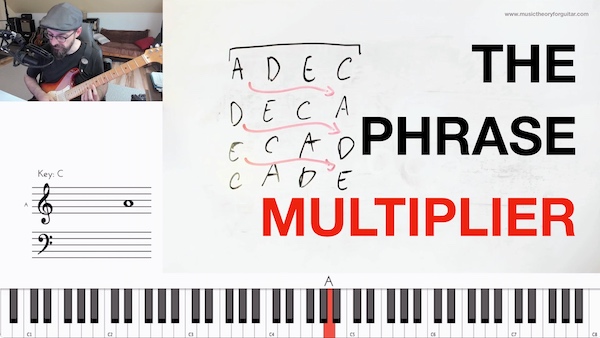
What I'm going to do is that I'm going to continue this series of notes with the same four notes. But before I continue, I do this. I take the first note of the sequence and I put it last. So I'm going to take the D moves here, the E moves here, the C moves here, and the A moves at the end.
So the only thing I did was to take this A and move it at the end. And then I do the same thing again. I take the first note here and then move it at the end. And so the E moves here, the C moves here, the A moves here, and again, the D moves here at the end.
Every time, literally, I'm just doing this. I'm taking the first note and then moving it to the end. I can do it another time. So the E will go at the end and then C, A, D.
And so what I'm going to do right now, and again, this is just moving it at the end. That's the moment where people go like, are you just taking the first note and moving it at the end? This is impossible. This is too simple. It will never work.
And then what I did, I was playing just the first three of these. I could play only two. I could play three of them. I could play all four. I actually can keep going. Then it starts repeating.
So the idea that I was playing A, B, E, C, which is the first line, then D, E, C, A, D, which is the second line, and then E, C, A, D, which is the third line. I could also play the C, A, D, E, which is the last line.
So essentially, I'm just playing, I'm taking the notes I decided to put as input. I take the first note of those, put it at the end, and then chain all those things together.
Then, again, I don't have to play all of them. That's important. I don't have to play all of them. This is not a mathematical constraint that you have to do it.
I can stop any time. In fact, I can stop halfway through. I can play the full first line, the full second line, and just E and C. Da-da-da-da-da-da-da-da-da-da. Okay.
And then would be enough. I mean, this is not a set length. I can cut it everywhere.
But the idea basically is you take your kernel of notes, okay, the starting note, anything, anything you have, any idea you have, and then you put the first note last. Again, it sounds too simple. And that's why nobody's doing it.
Okay. Actually, many professionals are doing this. Actually, many professionals don't even know they are doing this because they have it in their ear. And then actually, they kind of learn it by osmosis from what they listen to, from the solos they listen to, etc. But the trick is this. I mean, that's one of the tricks, not all the tricks.
But this trick takes you surprisingly far. Surprisingly far. Surprisingly far. For how simple it is, for how obvious and stupid it is. This takes you surprisingly far.
Again, I can do this. I played two phrases at the beginning of this video. I played this one. And again, it was only the first three. The second phrase I played was pretty much similar. I just take other four notes. The next starting point was D, C, A, G.
Okay. But rather than doing that, I want to do it with three notes. Because with three notes, you get a specific, different rhythm. Okay.
So, let's take three notes. Let's take three random notes. Let's say I'm here in the pentatonic. And I'm playing C, D, E on a backing track maybe of A minor. I'm playing C, D, E.
And again, my case, my scenario here is that I may be composing. And I have all the time in the world. Or maybe I'm improvising. And then I'm doing this in real time.
And this, it's a simple idea. It looks complicated to calculate. But if you spend some time trying to do it while you improvise, you actually get the sound of it. And then you don't have to actually think about it mathematically. Because it is a specific sound. And your ear learns to recognize it.
My first, let's say I'm playing on a backing track of A minor 7th. And then my notes are C, D, E. Again, what I'm going to do is I'm going to take the first note and put it last. And take the two notes here, D, E, C. And then I'm going to take the first note and put it last. And take E and C here.
And again, what I'm going to do, I'm going to play the first line, the second line, the third line in order as they are. And I can cut them any time, I can stop any time. So C, D, E, D, E, C, E, C, D.
There's more than one way of playing this, of course. I mean, you can play this on two strings. Or on the same string.
So nothing strange here. I just noticed that I wrote where there is the camera. I'm so sorry. I'm going to rewrite this on the side.
But again, it's the same thing. My notes are C, D, E. The C goes last, D, E. The D goes last, E, C.
It is a very specific sound. This works really well for jazz. Like this.
Meet it again. Like this. But it works great for rock too. For rock, this will sound in a slightly different way. Let's say I still have those three notes. But for rock, typically I don't play a plain chain of eight notes. For rock, the rhythm has more variations.
Okay, let me actually put this. Let's say my phrase originally is... So the first note is long. The second note is short. And the third note is long. And I keep doing the same. Long, short, long.
Okay. You can call this a phrase multiplier. You get any simple melody that comes to your mind. You get anything that you can play that comes to your mind. And you can multiply what you can do with that.
I mean, it's fairly normal to get ideas like... Let's say something like this. That's a typical rock idea. Okay.
It's a very specific rhythm. Right? And the notes are E, D, C, A. So very simply, I'm taking the E and putting it at the end. Which means now I'm starting from the D, C, A, and E. So rather than playing... I keep the rhythm, but play...
Keep going. Every time I'm taking the first note, I'm putting it last. Okay.
That's a simple trick. But when I'm improvising... Okay. When I'm improvising and I come across two or three notes that I like, or a rhythm I like, I can apply this trick. In real time. And I can keep going on on the same note. And make it as if I'm inventing something new. I'm not really inventing anything new.
And actually, it's good. Because it's not a completely different phrase. We are not going to play completely different random phrases. Which makes the improvisation sound very disconnected. I'm just playing something related to the previous phrase.
So again, that's a little trick. To create a chain of notes. Or to create a variation of phrases. And if you sit down and try to do this in your improvisation... You're going to see how our improvisation gets better.
Now, in addition to that... I just played Pentatonic Scale right now. So it pays for you to get to Pentatonic Scale and sound good. And one thing you can do is to check this e-book here. It's a completely free e-book. It's on my website. You go to the link below.
It's 18 Tips for Making Your Pentatonic Solo Sound Professional. It's free. No string attached. You go there. Download it. And what you're going to get is that... If you learn two or three of those tips... It's going to change completely the way you play.
Because normally people learn a lot of licks on their Pentatonic Scales. But licks are not what makes you sound good. Those are the basic building blocks behind the lick. They come before the lick. You learn those. You can create new licks out of them. That still sound in style. Whether it's rock or fusion or jazz, etc.
But they allow you to be more creative with your guitar. And again, you just need to learn two or three. You can learn all of them, of course. But just learn two or three. Start using them in your playing. And you'll see the difference.
Okay? Now, this is Tomaso Zillia. I'm MrDifferentGuitar.com. And until next time... Enjoy.